



 (408) 744-9040
Ion Gauges

|
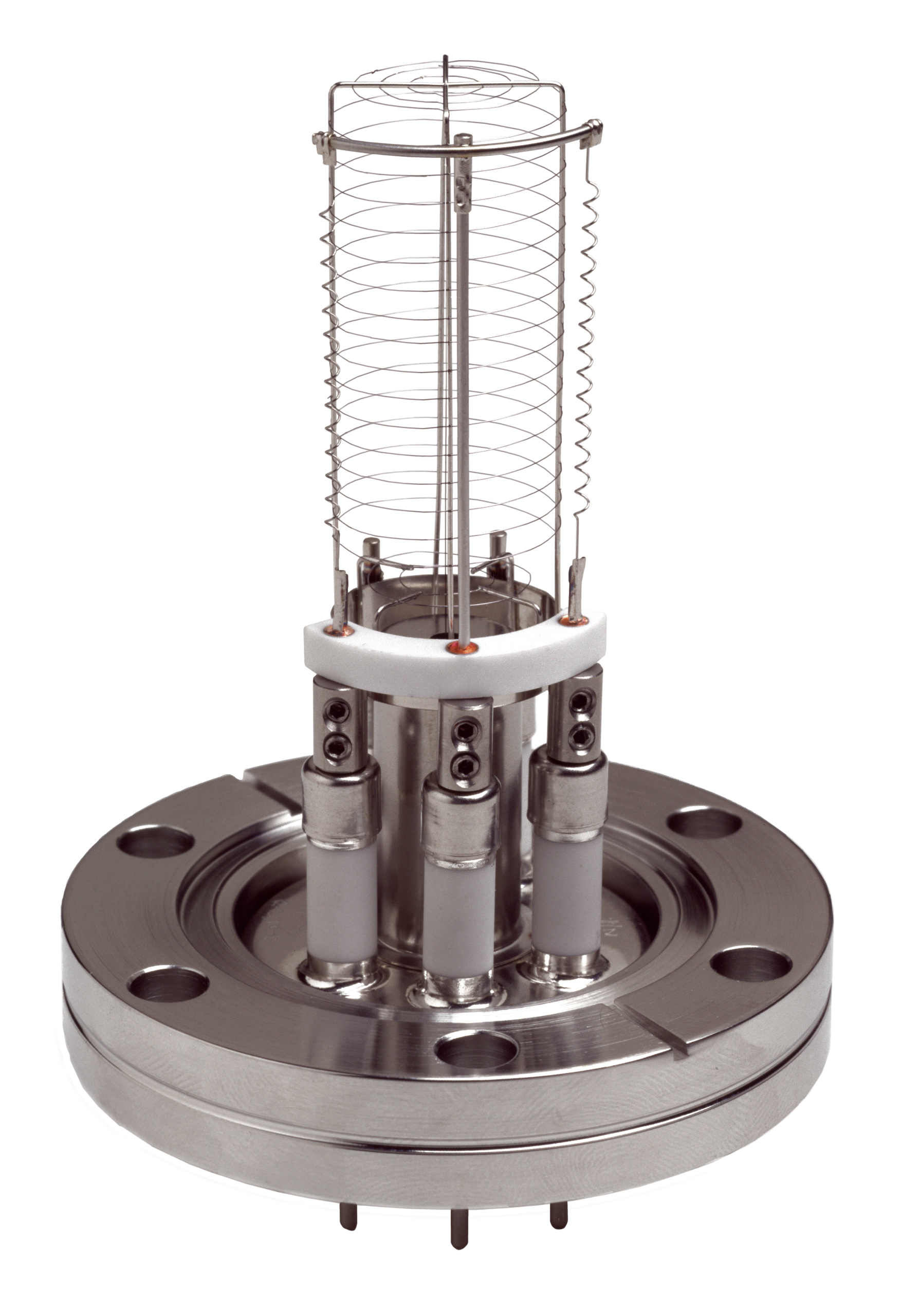
SRS offers three types of gauges for the IGC100 Ion Gauge Controller: glass-tubulated, nude, and nude-UHV Bayard-Alpert ionization gauges. We also supply convection-enhanced Pirani gauges. All single, hair-pin shaped filaments used in SRS gauges are spring tensioned to eliminate filament sag. This allows the user to mount the gauge in any orientation. |
SRS Ion Gauges
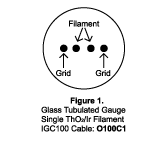
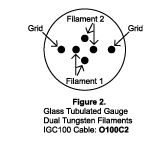
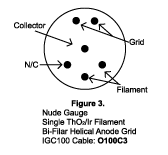
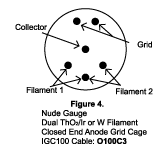
Once you have selected a gauge, choose the appropriate cable using the pin connector diagram below.
BA Gauge Pin Connector Configuration
Product # |
Available Bayard-Alpert Ionization Gauges |
GR-100F |
2.75" CF, 1" side tube, single filament, ThO2/Ir |
GW-100F |
2.75" CF, 1" side tube, dual filament, tungsten |
NR-F |
Nude, bi-filar helix grid, dual filament, ThO2/Ir |
NR-F-UHV |
Nude, closed cage grid, dual filament, ThO2/Ir |
NW-F-UHV |
Nude, closed cage grid, dual filament, tungsten |
| Type | Description | Pin Config/ SRS Cable# |
SRS Part# |
Granville -Phillips |
ETI | Duniway Stockroom |
Kurt J. Lesker |
Varian | ||
| Glass Tubulated |
Connection | Filament Material |
||||||||
| Type | Diameter | (count) | ||||||||
| Metal Tube Kovar) |
0.75 in. | ThO2/Ir (single) |
Fig. 1 | GR-075K* | 274003 | 4336K | I-075-K | G075K | K2471305 | |
| tungsten dual) |
Fig. 2 | GW-075K* | 274013 | 4336TK | T-075-K | G075TK | K7360304 | |||
| 2.75" Conflat® Flange |
1 in. side tube |
ThO2/Ir (single) |
Fig. 1 | GR-100F | 274008 | 4336F/1 | I-CFF-275 | G100F | K2471303 | |
| tungsten (dual) |
Fig. 2 | GW-100F | 274018 | 4336TF/1 | T-CFF-275 | G100TF | K7360307 | |||
| Nude (2.75" CF flange) |
Range | Anode Grid |
Filament Material (count) |
|||||||
| Std. | Bi-filar Helix |
ThO2/Ir (single) |
Fig. 3 | NR-F | 274028 | 8140 | I-NUDE-BAC | G8140 | L5150-302 | |
| UHV | closed end cage |
ThO2/Ir (dual) |
Fig. 4 | NR-F-UHV | 274023 | 8130 | I-NUDE-F | G8130 | 971-5007 | |
| UHV | closed end cage |
tungsten (dual) |
Fig. 4 | NW-F-UHV | 274022 | 8130T | T-NUDE-F | G8130T | 971-5008 | |
| Glass Tubulated | Nude | Nude-UHV | |
Physical Data |
|||
| Connection | Side tube or 2.75" CF flange | 2.75" CF flange | 2.75" CF flange |
| Side tube diameter | 0.75" or 1" | N.A | N.A |
| Side tube material | Pyrex or Kovar (#1) | N.A | N.A |
| Envelope | Nonex 7720 Glass, 2.25" dia. × 5.25" long |
Nude | Nude |
| Mounting position | Any, vertical preferred (#2) | Any | Any |
| Collector | Tungsten, 0.05" diameter | Tungsten, 0.05" diameter | Tungsten, 0.05" diameter |
| Filament | Single ThO2/Ir (#4) or dual tungsten | Single ThO2/Ir (#4), replaceable | Dual ThO2/Ir or dual tungsten, replaceable |
| Grid | Tungsten, bi-filar helix configuration | Tungsten, bi-filar helix configuration | Tantalum and Pt/Moly support, closed end "squirrel" cage |
| Overall length, max. | 6.0" | 4.13" | 4.13" |
| Insertion length, max. | N.A. | 3.30" | 3.00" |
Operating Data |
|||
| Operating pressure | 2 × 10⁻¹⁰ to 10-3 Torr | 4 × 10⁻¹⁰ to 10-3 Torr | 2 × 10-11 to 10-3Torr |
| Sensitivity for N2 (nominal) | 10/Torr | 10/Torr | 25/Torr |
| X-ray limit | 2 × 10⁻¹⁰ Torr | 4 × 10⁻¹⁰ Torr | 2 × 10-11 Torr |
| Electron bombardment degas, Power @500V |
70 W (nominal), 100 W (max.) | 70 W (nominal), 100 W (max.) | 40 W (max.) |
| Resistance heated degas | 6.3 to 7.5 V @ 10 A | 6.3 to 7.5 V @ 10 A | N.A. |
| Bakeout temperature | 250 °C | 450 °C | 450 °C |
Electrical Operating Parameters (#3) |
|||
| Anode grid bias voltage | 180 VDC | 180 VDC | 180 VDC |
| Collector bias voltage | 0 VDC | 0 VDC | 0 VDC |
| Filament bias voltage | 30 VDC | 30 VDC | 30 VDC |
| Filament supply current | 4 to 6 A | 4 to 6 A | 4 to 6 A |
| Filament supply voltage | 3 to 5 VDC | 3 to 5 VDC | 3 to 5 VDC |
| Notes: 1. Glass-to-metal transition 2. Vertical orientation provides strain relief for electrode structures increasing long-term stability 3. Direct current (DC) bias and supply voltages are recommended for all electrical connections. 4. Single filaments are hair-pin shaped and spring loaded to eliminate sagging. |
|||



