



 (408) 744-9040
DS360 Function Generator

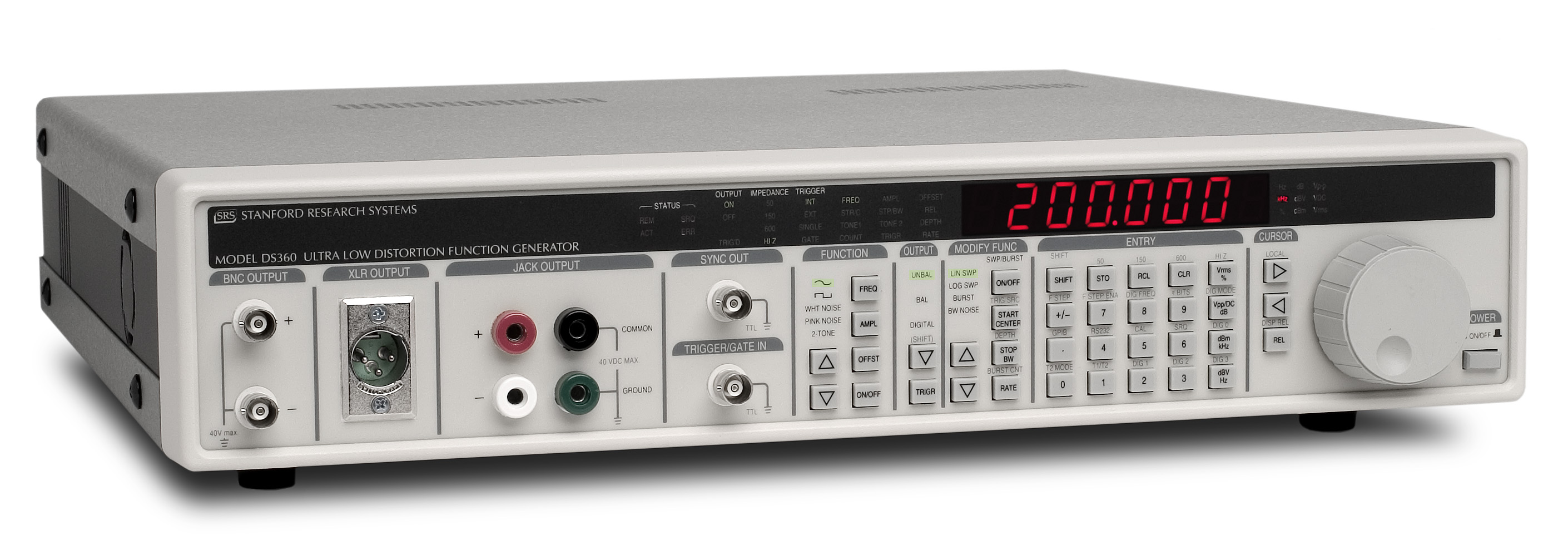
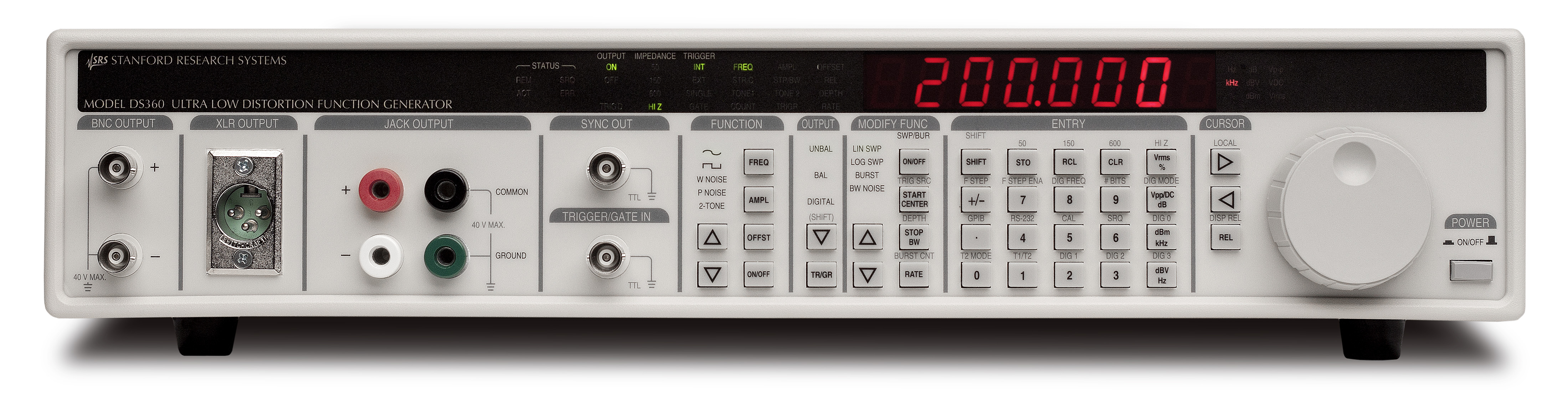
| The performance of a low distortion analog source and the precision of direct digital synthesis (DDS) is combined in the DS360. With less than 0.001 % total harmonic distortion (THD), 25 ppm frequency accuracy, and a broad range of features including sweeps and bursts, the DS360 is the ideal source for audio frequency applications. |
DS360 Function Generator
DS360 Function Generator
DS360 Low-Distortion Function Generator
DS360
The performance of a low distortion analog source and the precision of direct digital synthesis (DDS) is combined in the DS360. With less than 0.001 % total harmonic distortion (THD), 25 ppm frequency accuracy, and a broad range of features including sweeps and bursts, the DS360 is the ideal source for audio frequency applications.
Ultra-Low DistortionUltra-Low Distortion
|
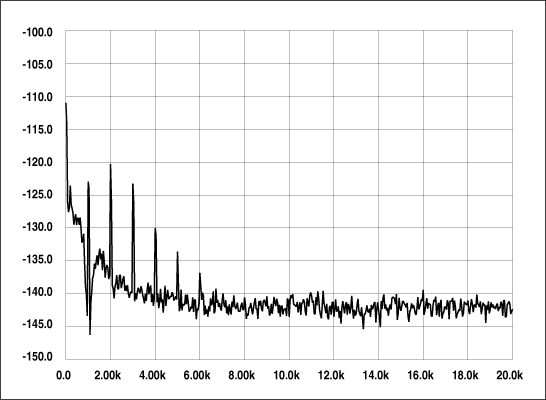
Unlike conventional RC oscillators, the DS360 uses digital signal processing and a precision
Frequency Stability
Low-distortion analog sources have impressive THD specifications but suffer with poor frequency accuracy and resolution. The DS360 delivers 0.0025 % frequency accuracy over its entire frequency range. It has
Waveforms
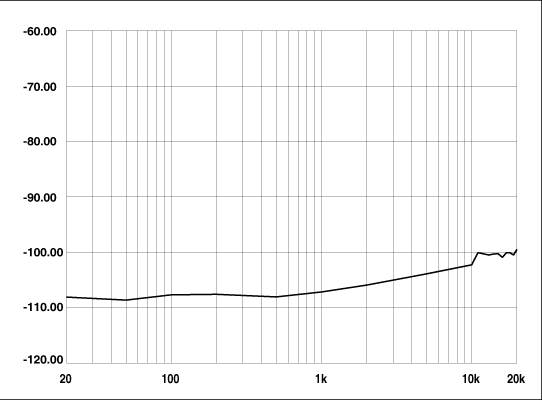
DS360 THD+N vs. FrequencyDS360 THD+N vs. Frequency
|
The DS360 generates clean sine waves and square waves, as well as a
Audio Outputs
All functions and parameters are easily set using the front-panel keypad and spin knob. A wide variety of amplitude units including Vrms, Vpp, dBV, dBm and dBrel can be selected.
Sweeps and Bursts
Unlike single frequency analog sources, the DS360 generates low-distortion frequency sweeps over its entire frequency range. Linear and log sweeps are set between 10 mHz and 200 kHz with sweep times between 0.3 ms and 100 s. Sweeps can be single-shot or repetitive, and the instrument can sweep both up and down in frequency. The DS360 provides outstanding amplitude flatness (0.5 % up to 20 kHz) during frequency sweeps, and has a TTL level sweep marker output for synchronizing external equipment.
The DS360 also creates tone bursts of sine waves and square waves. The number of ON cycles, repetition rate, and the OFF amplitude level can all be adjusted. Sweeps and bursts may be triggered from the internal rate generator or an external trigger, or they can be externally gated.
Computer Control
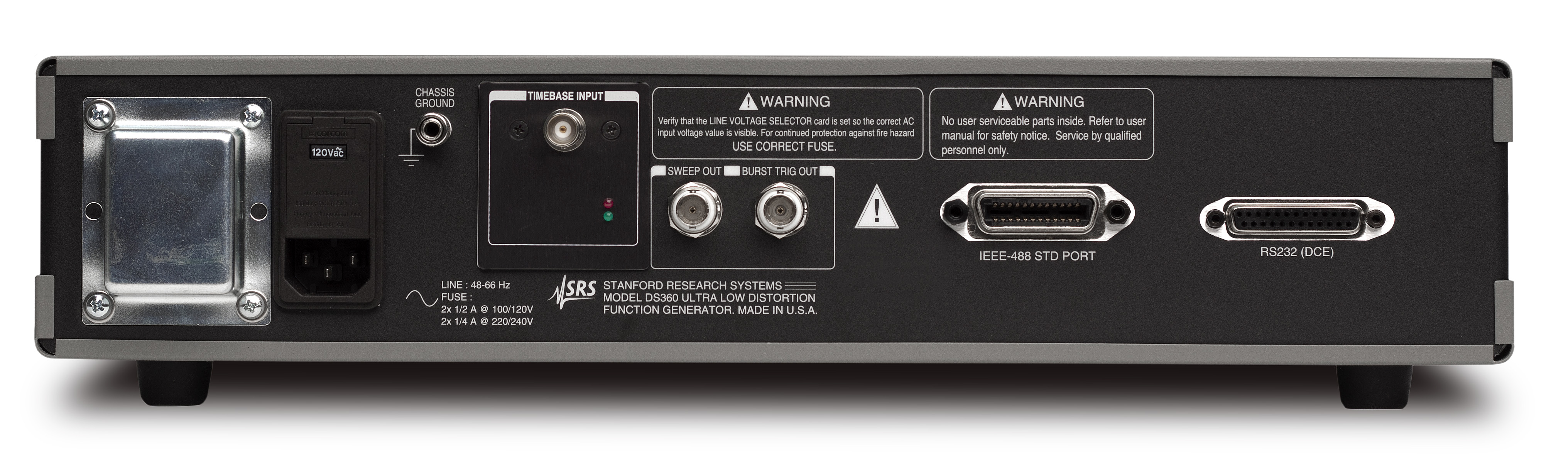
The DS360 is designed for benchtop use as well as automated testing. With standard
DS360 Specifications |
|
Sine |
|
| THD | (1 Vrms unbal., 2 Vrms bal.) |
| (<5 kHz) | -110 dB (typ.), -106 dB (max.) |
| (5 to 20 kHz) | -104 dB (typ.), -98 dB (max.) |
| (20 to 40 kHz) | -100 dB (typ.), -96 dB (max.) |
| (40 to 100 kHz) | -90 dB (typ.), -85 dB (max.) |
| (100 to 200 kHz) | -76 dB (typ.), -68 dB (max.) |
| THD | (10 Vrms unbal., 20 Vrms bal.) |
| (<5.0 kHz) | -109 dB (typ.), -105 dB (max.) |
| (5 to 20 kHz) | -103 dB (typ.), -98 dB (max.) |
| (20 to 40 kHz) | -98 dB (typ.), -93 dB (max.) |
| (40 to 100 kHz) | -88 dB (typ.), -83 dB (max.) |
| (100 to 200 kHz) | -76 dB (typ.), -68 dB (max.) |
Square |
|
| Frequency range | 0.01 Hz to 200 kHz |
| Rise time | 1.3 µs |
| Even harmonics | < -60 dBc (to 20 kHz) |
White Noise |
|
| Bandwidth | DC to 200 kHz |
| Flatness | <1.0 dB, 1 Hz to 100 kHz |
| Crest factor | 11 dB |
Pink Noise |
|
| Bandwidth | 10 Hz to 200 kHz |
| Flatness | < 3.0 dB, 20 Hz to 20 kHz (measured using 1/3 octave analysis) |
| Crest factor | 12 dB |
Bandwidth Limited Noise |
|
| Bandwidth | 100 Hz, 200 Hz, 400 Hz, 800 Hz, 1.6 kHz, 3.2 kHz, 6.4 kHz, 12.8 kHz, 25.6 kHz, 51.2 kHz, 102.4 kHz |
| Center frequency | 0 Hz to 200.0 kHz (200 Hz increments) |
| Flatness (in band) | <1.0 dB |
| Crest factor | |
| Baseband | 12 dB (0 Hz center frequency) |
| Non-baseband | 15 dB |
Two-Tone |
|
| Type | Sine-sine, sine-square |
| Sine frequency | 0.01 Hz to 200 kHz |
| Square frequency | 0.1 Hz to 5 kHz |
| Square resolution | 2 digits |
| SFDR | >90 dB |
Sine or Square Burst |
|
| On cycles | 1/2, 1 to 65534 cycles |
| Repetition rate | 1 to 65535 cycles |
| Triggering | Internal, external, single-shot, externally gated |
| Off level | 0.0 % to 100.0 % (of on level) |
| Off resolution | 0.1 % |
| Max. off attenuation | -90 dBc (1 kHz) -70 dBc (10 kHz) -50 dBc (100 kHz) |
White or Pink Noise Burst |
|
| On time | 10 µs to 599.9 s |
| Repetition time | 20 µs to 600 s |
| Triggering | Internal, external, single-shot, externally gated |
| Off level | 0.0 % to 100.0 % (of on level) |
| Resolution | 0.1 % |
Sine or Square Sweep |
|
| Type | Linear or logarithmic |
| Range | 0.01 Hz to 200.000 kHz |
| Rate | 0.1 Hz to 3.1 kHz |
| Resolution | 2 digits |
| Flatness | ±0.1 dB (1 %) |
Frequency |
|
| Resolution | 6 digits or 10 mHz (whichever is greater) |
| Accuracy | 25 ppm (0.0025 %) + 4 mHz (20 °C to 40 °C) |
Amplitude |
|
| Unbalanced outputs (+ output only)* |
5.0 µVpp to 14.4 Vpp (50 Ω load) 5.0 µVpp to 20.0 Vpp (600 Ω load) 10.0 µVpp to 40.0 Vpp (Hi-Z load) |
| Balanced outputs | 10 µVpp to 28.8 Vpp (50 Ω load) 10 µVpp to 28.8 Vpp (150 Ω load) 10 µVpp to 40.0 Vpp (600 Ω load) 20 µVpp to 80.0 Vpp (Hi-Z load) |
| Resolution | 4 digits or 1 µV, whichever is greater (Vpp or Vrms), 0.1 dB (dBm or dBV) |
| Accuracy | |
| Sine, Square, 2-Tone | ±0.1 dB (1 %) |
| White Noise | ±0.175 dB (2 %) |
| Pink Noise | ±0.35 dB (4 %) |
| * - output amplitude is specified only in balanced mode. | |
Broadband Noise |
|
| 1 kHz sine into high impedance load (>1 kΩ) | |
| <12.6 mVpp 12.6 mVpp to 126 mVpp 126 mVpp to 1.26 Vpp 1.26 Vpp to 10 Vpp 10 Vpp to 40 Vpp |
<4 nV/√Hz <7.5 nV/√Hz <15 nV/√Hz <100 nV/√Hz <500 nV/√Hz |
Offset |
|
| Unbalanced output | 0 to ±7.4 VDC (50 Ω load) 0 to ±10.0 VDC (600 Ω load) 0 to ±20.0 VDC (Hi-Z load) |
| Balanced output | Not active |
| Resolution | 3 digits |
| Accuracy | (all except pink noise) 1 % ± 25 mV (Vp+offset > 0.63 V) 1 % ± 2.5 mV (0.63 V > Vp+offset > 0.063 V) 1 % ± 250 µV (63 mV > Vp+offset > 6.3 mV) 1 % ± 50 µV (Vp+offset < 6.3 mV) (pink noise) 1 % ± 200 mV (Vp+offset > 0.63 V) 1 % ± 20 mV (0.63 V > Vp+offset > 0.063 V) 1 % ± 2 mV (63 mV > Vp+offset > 6.3 mV) 1 % ± 200 µV (Vp+offset < 6.3 mV) |
Outputs |
|
| Configuration | Balanced and unbalanced |
| Connectors | Floating BNCs, banana plugs and XLR jack |
| Source impedance | |
| Balanced | 50 Ω ± 3 % 150 Ω± 2 % 600 Ω ± 1 % Hi-Z (50 Ω ± 3 %) |
| Unbalanced | 50 Ω ± 3 % 600 Ω ± 1 % Hi-Z (25 Ω ± 1 Ω) |
| Floating voltage | ±40 VDC (max.) |
10 MHz Reference Input (Opt. 03) |
|
| Requirements | Sine or TTL, 0.4 to 7 Vpp, 10 MHz ± 50 ppm |
| Stability | |
| Internal | ±25 ppm |
| External | Same as stability of ext. reference) |
| Indicators | External reference detected, Locked |
Other Outputs |
|
| Sync | TTL level (same frequency and phase as output) |
| Burst out | TTL pulse marks burst (TTL high for ON time) |
| Trigger/gate in | TTL pulse starts sweep or burst TTL high activates gated burst |
| Sweep | TTL pulse marks beginning of sweep |
General |
|
| Computer interfaces | GPIB and RS-232. All instrument functions can be controlled. |
| Size | 17" × 3.5" × 16.25" (WHL) |
| Weight | 17 lbs. |
| Power | 50 W, 100/120/220/240 VAC, 50/60 Hz |
| Warranty | One year parts and labor on defects in materials and workmanship |
DS360 Specifications |
|
Sine |
|
| THD | (1 Vrms unbal., 2 Vrms bal.) |
| (<5 kHz) | -110 dB (typ.), -106 dB (max.) |
| (5 to 20 kHz) | -104 dB (typ.), -98 dB (max.) |
| (20 to 40 kHz) | -100 dB (typ.), -96 dB (max.) |
| (40 to 100 kHz) | -90 dB (typ.), -85 dB (max.) |
| (100 to 200 kHz) | -76 dB (typ.), -68 dB (max.) |
| THD | (10 Vrms unbal., 20 Vrms bal.) |
| (<5.0 kHz) | -109 dB (typ.), -105 dB (max.) |
| (5 to 20 kHz) | -103 dB (typ.), -98 dB (max.) |
| (20 to 40 kHz) | -98 dB (typ.), -93 dB (max.) |
| (40 to 100 kHz) | -88 dB (typ.), -83 dB (max.) |
| (100 to 200 kHz) | -76 dB (typ.), -68 dB (max.) |
Square |
|
| Frequency range | 0.01 Hz to 200 kHz |
| Rise time | 1.3 µs |
| Even harmonics | <-60 dBc (to 20 kHz) |
White Noise |
|
| Bandwidth | DC to 200 kHz |
| Flatness | <1.0 dB, 1 Hz to 100 kHz |
| Crest factor | 11 dB |
Pink Noise |
|
| Bandwidth | 10 Hz to 200 kHz |
| Flatness | < 3.0 dB, 20 Hz to 20 kHz (measured using 1/3 octave analysis) |
| Crest factor | 12 dB |
Bandwidth Limited Noise |
|
| Bandwidth | 100 Hz, 200 Hz, 400 Hz, 800 Hz, 1.6 kHz, 3.2 kHz, 6.4 kHz, 12.8 kHz, 25.6 kHz, 51.2 kHz, 102.4 kHz |
| Center frequency | 0 Hz to 200.0 kHz (200 Hz increments) |
| Flatness (in band) | <1.0 dB |
| Crest factor | |
| Baseband | 12 dB (0 Hz center frequency) |
| Non-baseband | 15 dB |
Two-Tone |
|
| Type | Sine-sine, sine-square |
| Sine frequency | 0.01 Hz to 200 kHz |
| Square frequency | 0.1 Hz to 5 kHz |
| Square resolution | 2 digits |
| SFDR | >90 dB |
Sine or Square Burst |
|
| On cycles | 1/2, 1 to 65534 cycles |
| Repetition rate | 1 to 65535 cycles |
| Triggering | Internal, external, single-shot, externally gated |
| Off level | 0.0 % to 100.0 % (of on level) |
| Off resolution | 0.1 % |
| Max. off attenuation | -90 dBc (1 kHz) -70 dBc (10 kHz) -50 dBc (100 kHz) |
White or Pink Noise Burst |
|
| On time | 10 µs to 599.9 s |
| Repetition time | 20 µs to 600 s |
| Triggering | Internal, external, single-shot, externally gated |
| Off level | 0.0 % to 100.0 % (of on level) |
| Resolution | 0.1 % |
Sine or Square Sweep |
|
| Type | Linear or logarithmic |
| Range | 0.01 Hz to 200.000 kHz |
| Rate | 0.1 Hz to 3.1 kHz |
| Resolution | 2 digits |
| Flatness | ±0.1 dB (1 %) |
Frequency |
|
| Resolution | 6 digits or 10 mHz (whichever is greater) |
| Accuracy | 25 ppm (0.0025 %) + 4 mHz (20 °C to 40 °C) |
Amplitude |
|
| Unbalanced outputs | 5.0 µVpp to 14.4 Vpp (50 Ω load) 5.0 µVpp to 20.0 Vpp (600 Ω load) 10.0 µVpp to 40.0 Vpp |
| Balanced outputs | 10 µVpp to 28.8 Vpp (50 Ω load) 10 µVpp to 28.8 Vpp (150 Ω load) 10 µVpp to 40.0 Vpp (600 Ω load) 20 µVpp to 80.0 Vpp |
| Resolution | 4 digits or 1 µV, whichever is greater. (Vpp or Vrms, 0.1 dB (dBm or dBV)) |
| Accuracy | |
| Sine, Square, 2-Tone | ±0.1 dB (1 %) |
| White Noise | ±0.175 dB (2 %) |
| Pink Noise | ±0.35 dB (4 %) |
Broadband Noise |
|
| 1 kHz sine into high impedance load (>1 kΩ) | |
| <12.6 mVpp 12.6 mVpp to 126 mVpp 126 mVpp to 1.26 Vpp 1.26 Vpp to 10 Vpp 10 Vpp to 40 Vpp |
<4 nV/√Hz <7.5 nV/√Hz <15 nV/√Hz <100 nV/√Hz <500 nV/√Hz |
Offset |
|
| Unbalanced output | 0 to ±7.4 VDC (50 Ω load) 0 to ±10.0 VDC (600 Ω load) 0 to ±20.0 VDC (Hi-Z load) |
| Balanced output | Not active |
| Resolution | 3 digits |
| Accuracy | Applies to "+" output only (Sine, square (≤120 kHz), white noise, 1 % ± 25 mV (Vp + offset > 0.63 V) 1 % ± 2.5 mV (0.63 V > Vp+offset > 0.063 V) 1 % ± 250 µV (63 mV > Vp + offset > 6.3 mV) 1 % ± 50 µV (Vp + offset < 6.3 mV) (All others) 1 % ± 300 mV (Vp+offset > 0.63 V) 1 % ± 20 mV (0.63 V > Vp + offset > 0.063 V) 1 % ± 2 mV (63 mV > Vp + offset > 6.3 mV) 1 % ± 200 µV (Vp + offset < 6.3 mV) |
Outputs |
|
| Configuration | Balanced and unbalanced |
| Connectors | Floating BNCs, banana plugs and XLR jack |
| Source impedance | |
| Balanced | 50 Ω ± 3 % 150 Ω± 2 % 600 Ω ± 1 % Hi-Z (50 Ω ± 3 %) |
| Unbalanced | 50 Ω ± 3 % 600 Ω ± 1 % Hi-Z (25 Ω ± 1 Ω) |
| Floating voltage | ±40 VDC (max.) |
10 MHz Reference Input (Opt. 03) |
|
| Requirements | Sine or TTL, 0.4 to 7 Vpp, |
| Stability | |
| Internal | ±25 ppm |
| External | Same as stability of ext. reference) |
| Indicators | External reference detected, Locked |
Other Outputs |
|
| Sync | TTL level (same frequency and phase as output) |
| Burst out | TTL pulse marks burst (TTL high for ON time) |
| Trigger/gate in | TTL pulse starts sweep or burst TTL high activates gated burst |
| Sweep | TTL pulse marks beginning of sweep |
General |
|
| Computer interfaces | GPIB and RS-232. All instrument functions can be controlled. |
| Size | 17" × 3.5" × 16.25" (WHL) |
| Weight | 17 lbs. |
| Power | 50 W, 100/120/220/240 VAC, 50/60 Hz |
| Warranty | One year parts and labor on defects in materials and workmanship |



