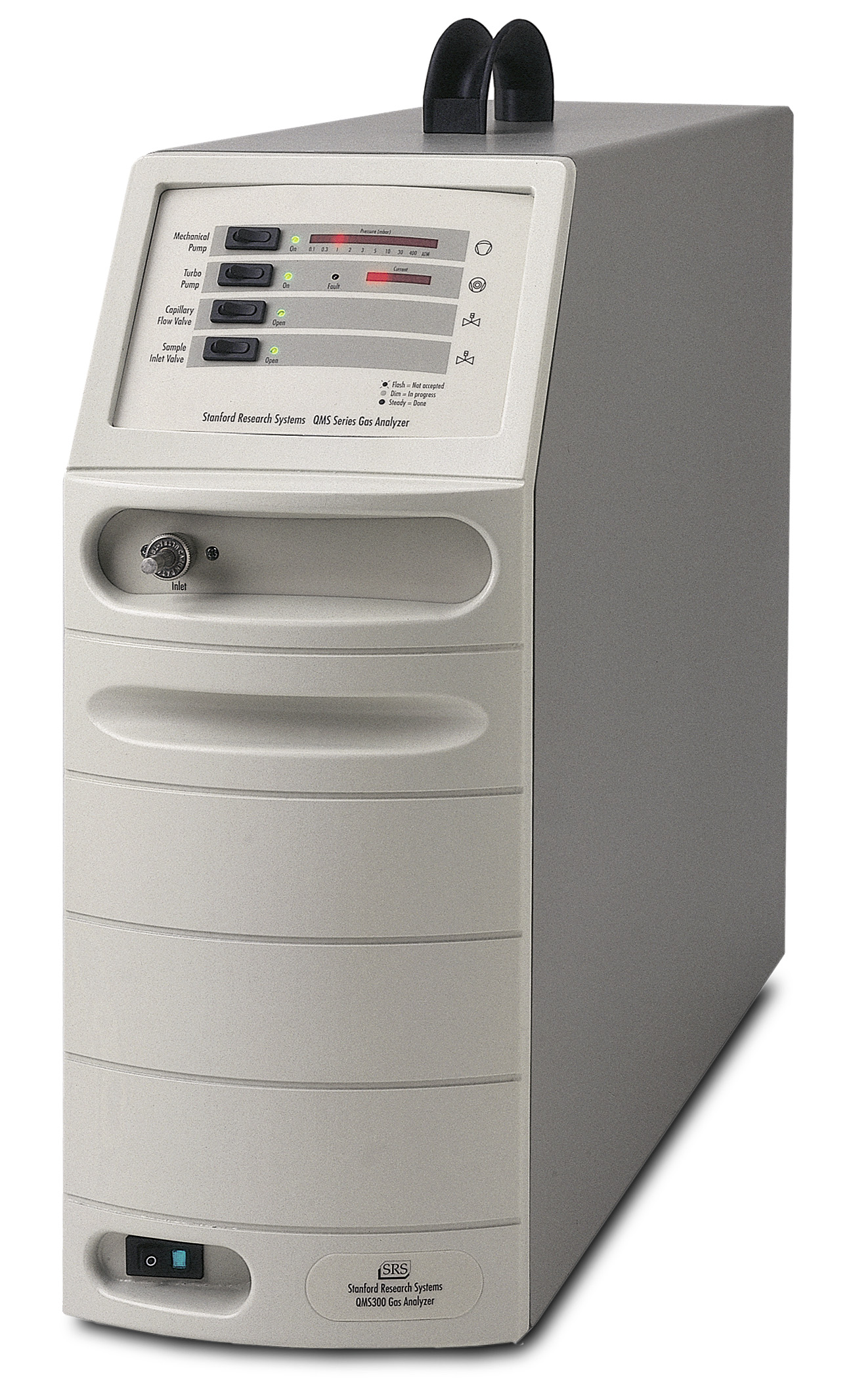
QMS series gas analyzers offer an efficient, cost-effective solution for a wide range of applications. These mass spectrometers simplify the task of on-line process monitoring, analysis of gas species, leak detection, and troubleshooting.
On-Line Monitoring
The QMS system can continuously sample gas at flow rates of several milliliters per minute. The inlet can be equipped to sample at pressures from 1 bar to 10 mbar. Data is acquired continuously, as opposed to batch sampling which is employed by gas chromatographs. The QMS has a fast response time of less than 0.5 seconds. Complete spectra can be recorded in seconds, and individual masses can be measured at rates up to 25 points per second.
Compact, User-Friendly Design
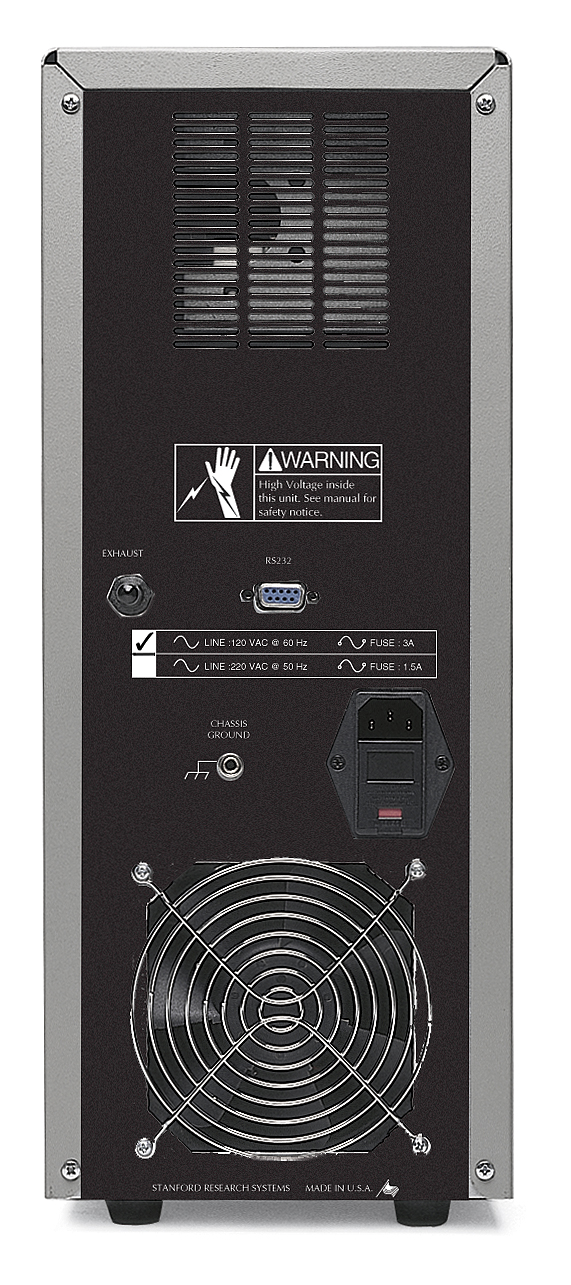
An advanced quadrupole mass spectrometer design, coupled with state-of-the-art pumping technology, allows the entire system to be integrated in a small, transportable package. The sampling inlet valves and pumps can be controlled from the front panel. Operation is easy and does not require a detailed understanding of the quadrupole or the pressure reducing inlet. Since the pumps contain no oil or other liquids, gravity has no effect on them which allows the unit to function either standing upright or laid on its side. Capillaries are used as sampling probes and are available in several materials and sizes for different applications.
Principle of Operation
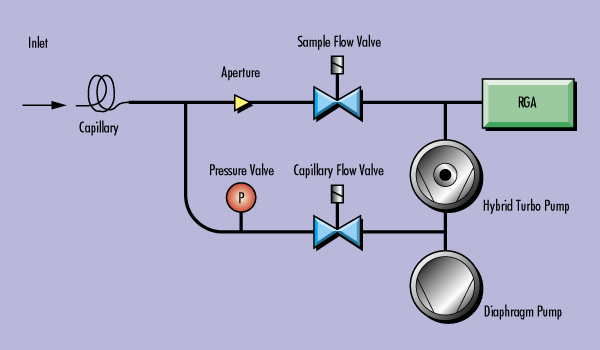
The QMS uses a two stage pressure reducing inlet to sample gases at high pressure. This allows the use of a residual gas analyzer (which operates at high vacuum) as the detector. Different capillaries permit the system to sample at higher or lower pressures. A large flow is drawn through the capillary which drops the pressure three decades. A hybrid turbomolecular/drag pump draws a small amount of gas through an aperture, which reduces the pressure to about
Bypass Flow Configuration
The bypass flow stream and the sample flow stream are recombined at the diaphragm pump, which makes it possible to use only one backing pump. This contributes to the system's small size. The bypass flow configuration is also critical to the fast response time of the QMS. Single-stage pressure reduction with leak valves would lead to extremely small flow rates and unreasonably long sample times. The bypass flow, on the other hand, gives a response time of less than 0.5 seconds from the tip of the capillary to the RGA chamber.
Windows Software
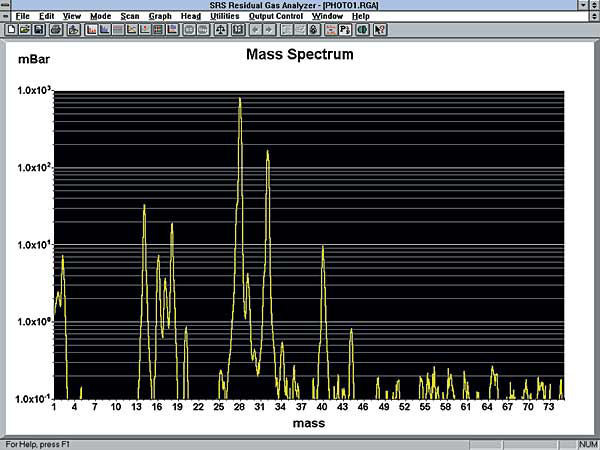
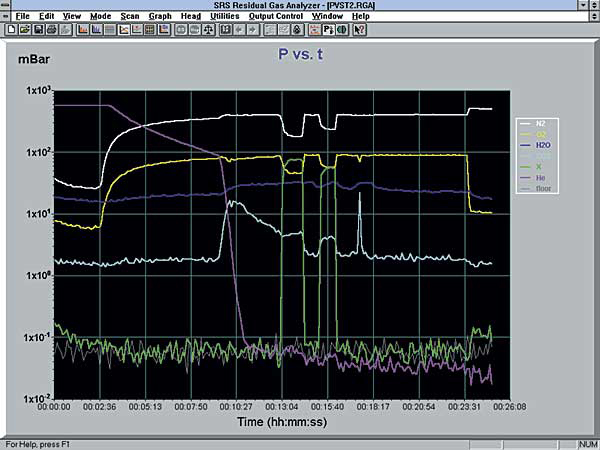
The QMS systems are supported with a Windows software package that runs on PCs. The intuitive graphical user interface allows measurements to be made quickly and easily. Data is captured and displayed in real-time or scheduled for acquisition at specified time intervals. Features include analog and histogram scan modes, pressure vs. time plots, leak detection, annunciator mode, gas library, audio and visual alarms, and comprehensive