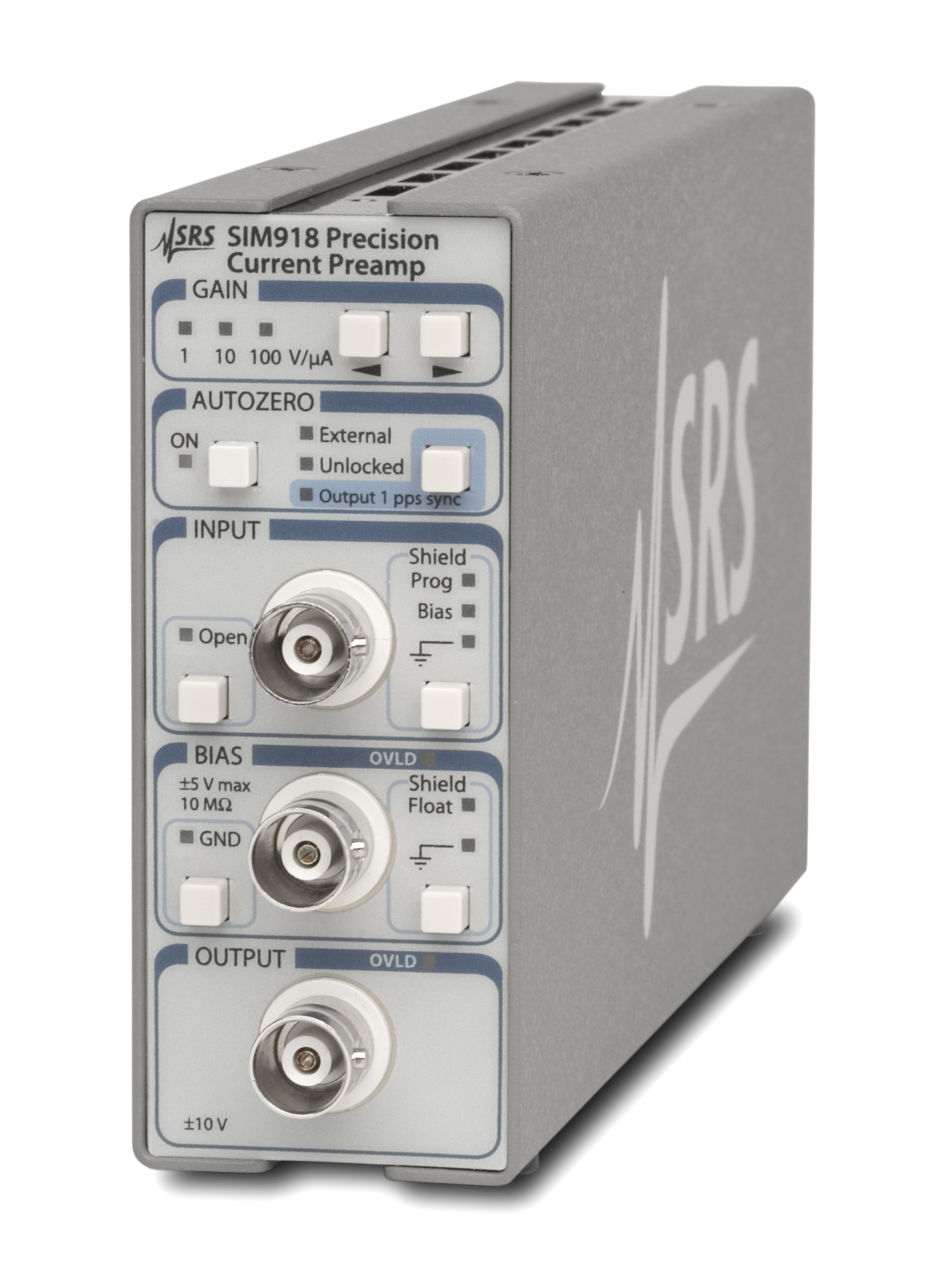
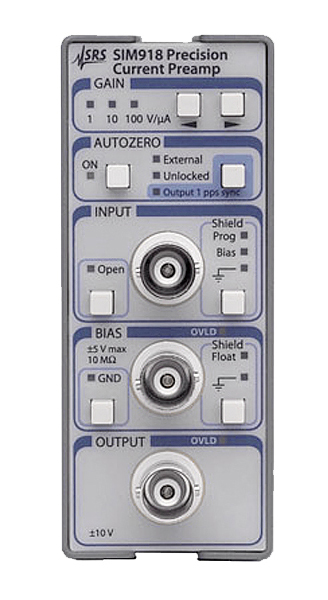
The SIM918 Current Preamplifier is ideal in applications in which the input offset voltage must be kept to a minimum. The DC voltage difference between the two inputs (current input and voltage bias) is accurately measured every 2 seconds, and is nulled. The result is a current amplifier with less than 10 µV input offset voltage. This autozeroing feature can be engaged or inhibited remotely or from the front panel, giving you flexibility in sensitive applications.
As a current amplifier, the SIM918 offers input noise as low as
There is a voltage bias input for setting the virtual ground potential to an external DC source. This input can range over ±5 V. The bias voltage can be internally grounded.
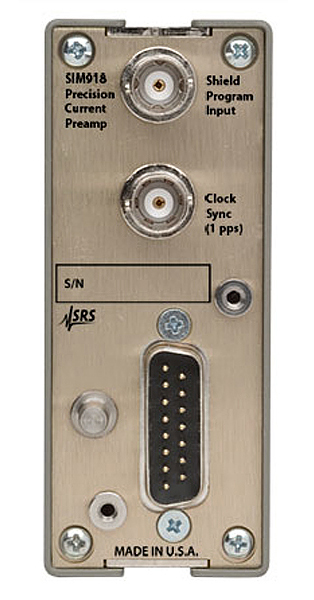
An autozero sync input/output connection is also provided. In the internal autozeroing mode, this port provides a one pulse-per-second (pps) output synchronous with the internal switching circuitry. In the external mode, a
The SIM918 provides maximum flexibility for cabling and grounding. The shield of the current input BNC can be switched between chassis ground, the bias voltage, or the rear-panel Program input (which can be left floating, if desired). With the Program input, a user can supply an excitation potential to an experiment via the shield conductor of the input cable, while the excited current flows through the center conductor to the SIM918. The shield of the voltage bias BNC can be independently grounded or floated.