| Search |
| Home > Products > Test & Measurement Instruments > SR1 |
|
| Audio Analyzer | SR1 ... from $9400 |
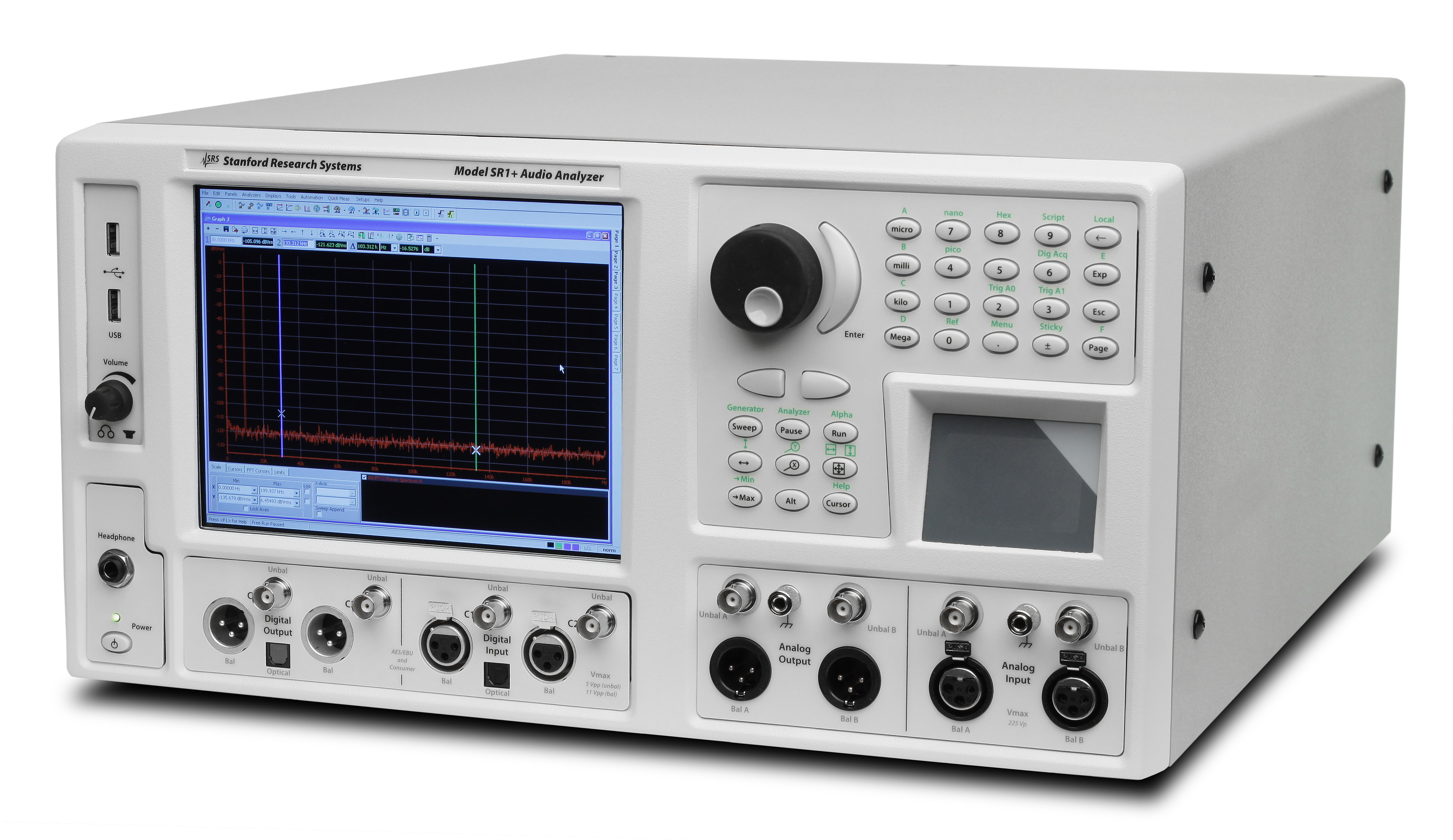
| SR1 — 200 kHz dual domain audio analyzer | |
| (Click to enlarge) |
SR1 Audio Analyzer
|
| SR1 Dual-Domain Audio Analyzer is a stand-alone instrument that delivers cutting edge performance in a wide variety of audio measurements. With a versatile high-performance generator, an array of analyzers that operate symmetrically in both the analog and digital domains, and digital audio carrier measurements at sampling rates up to 192 kHz, SR1 is the right choice for the most demanding analog and digital audio applications. |
| Related Products > PERF10 Rb Audio Clock > SR10/11/12 Audio Switchers |
| Downloads Datasheet User's Manual What's New with SR1 Advanced Chirp Signal |
| $ Prices |
SR1 Audio Analyzer
Introducing SR1 Dual-Domain Audio Analyzer - high performance audio analysis at a very affordable price.
SR1 Dual-Domain Audio Analyzer is a stand-alone instrument that delivers cutting edge performance in a wide variety of audio measurements. With a versatile high-performance generator, an array of analyzers that operate symmetrically in both the analog and digital domains, and digital audio carrier measurements at sampling rates up to 192 kHz, SR1 is the right choice for the most demanding analog and digital audio applications.
User Interface
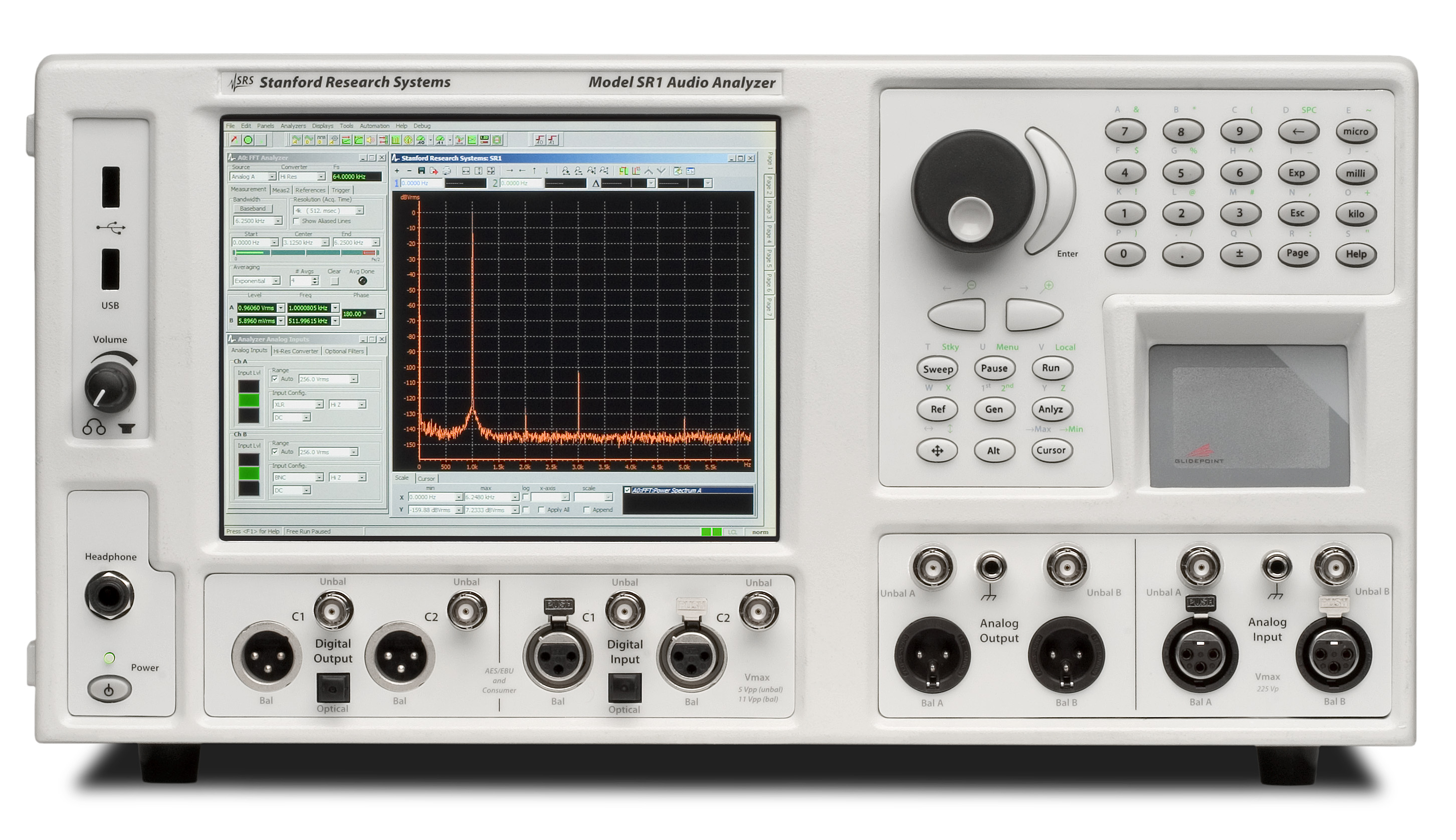
SR1 uses an integrated computer running the Windows XP embedded operating system, so operation will be immediately familiar and intuitive. Depending on the application, SR1 can be operated with an external mouse and keyboard, or by using the front-panel knob, keypad and touchpad.
Seven on-screen tabbed pages are available for arranging panels, graphs, and displays. Screen setups, data, and instrument configurations can be quickly saved and recalled to either the internal hard disk or to a flash drive connected to one of the two front-panel USB connectors. An optional 1024 x 768 XVGA monitor (opt. 02) provides better resolution and allows more information to be displayed.
While SR1’s configuration panels offer total flexibility in setting up every detail of the analyzer, at times it is useful to get a measurement going quickly, without worrying about infrequently used parameters. That’s where QuickMeas comes in. QuickMeas gives SR1 users the ability to get up and running on many common audio measurements such as Level, SNR, Frequency Response, and Crosstalk after answering just a few simple questions about the inputs and outputs of the DUT. When the measurements are finished, the results are available in a clear, easy-to-understand report.
Analog Signal Generator
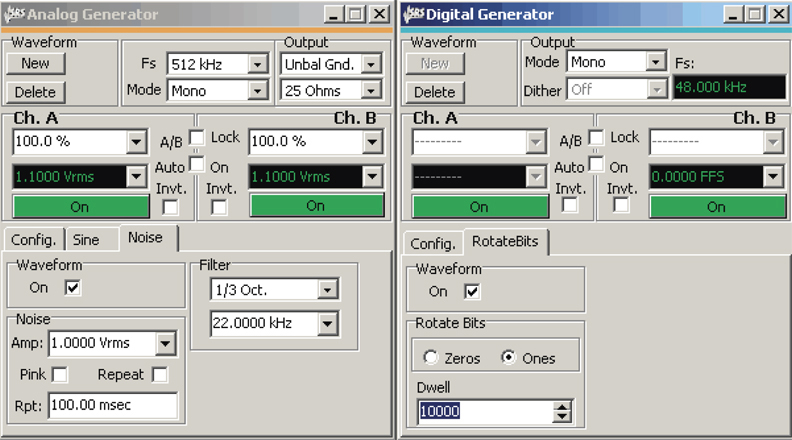
At the heart of SR1 is a uniquely flexible analog signal generator. All of the standard audio waveforms are available including sine, log-swept sine chirp, synchronous burst sine, noise (white, pink, and filtered), standard intermodulation test signals (SMPTE, CCIF, DIM), square waves, arbitrary waveforms (ASCII and .WAV), ramps and multitone waveforms. Many of these signals can be combined in the generator allowing you to create an unlimited number of test waveforms.
But the analog signal generator doesn’t sacrifice performance for flexibility. With a flatness of ±0.008 dB (20 Hz to 20 kHz) and a residual THD+N of -106 dB (20 Hz to 20 kHz), SR1’s Low Distortion Sine rivals the performance of any analyzer.
Multitone waveforms with up to 50 tones, each adjustable in frequency, amplitude, and phase are calculated and loaded in real-time, without having to run a cumbersome off-line program to generate arbitrary waveform tables. A convenient FFT Chirp waveform is automatically synchronized to the FFT analyzer allowing instant FFT measurements of frequency response (magnitude and phase).
Digital Audio Signal Generator
The same flexibility and performance is found in SR1’s digital audio signal generator. Almost all the same waveforms found in the analog generator are available in the digital generator with the addition of several special digital test waveforms including digital constant, walking bits, and a staircase waveform (for D/A testing).
The digital audio output sampling rate is continuously adjustable from 24 kHz to 216 kHz (single and dual connector). Full control over transmitted status bits (in both professional and consumer formats), user bits, and validity bits, is provided.
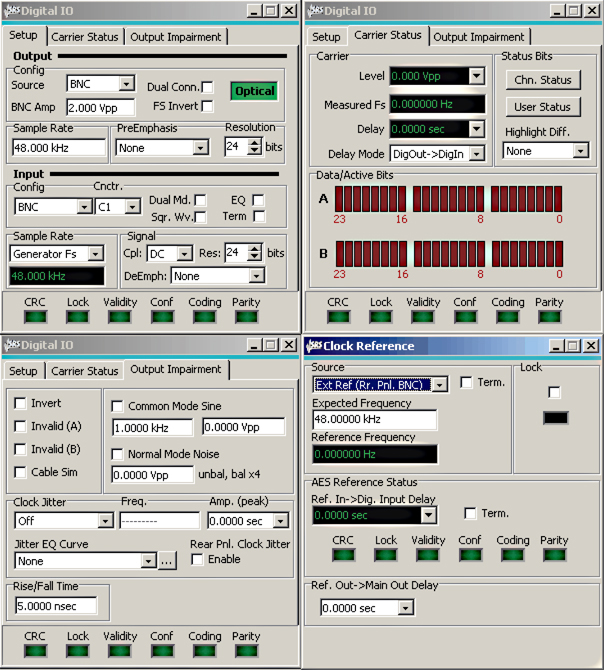
For digital interface testing, a variety of impairment signals can be imposed on the digital audio carrier. Carrier impairments include variable rise time (5 ns to 400 ns), common mode sine waves, normal mode noise, and several jitter waveforms (sine, square, and noise).
Timebase
All of SR1’s sampling clocks are derived from an internal timebase with 5 ppm accuracy. For the most demanding applications, an optional atomic rubidium (PERF) timebase is available with an accuracy at shipment of ±5 x 10-11, and a 20-year aging specification of )less than 5 ppb. Additionally, the timebase may be synchronized to an external clock, an AES11 reference signal, or any standard video signal.
Analyzers
The heart of SR1’s measurement abilities is its versatile set of analyzers which operate symmetrically on both analog and digital audio signals with no need to purchase additional options. Up to two analyzers can be run simultaneously on either the analog or
digital inputs.
The Time Domain Detector makes all of the standard audio measurements including Amplitude, Crosstalk, and THD+N. Continuously variable bandwidth limiting and standard weighting filters are included. The post notch-filter distortion signal can be fed to an FFT analyzer for a live spectral display of distortion, or to the rear-panel monitor output or speaker.
The Single-Channel FFT and Dual-Channel FFT Analyzers offer live spectral displays with full zoom and heterodyne capability. The full resolution of the analyzer can be applied to any frequency range down to 1/512th of the full measurement bandwidth, leading to an effective resolution of 16M FFT lines. Several averaging algorithms can be applied to bring out low level signals.
The two-channel FFT analyzer offers true single-shot frequency response measurements for the ultimate in accuracy. SR1 also has a complete set of impulse response measurements including impulse response, quasi-anechoic frequency response, and energy time-. curve. Since SR1 is a true two-channel FFT, it isn't limited to MLS waveforms, but can use virtually any waveform.
The THD Analyzer makes frequency selective THD measurements on two user-selectable sets of up to thirteen harmonics of the input signal.
The IMD Analyzer makes standard audio distortion measurements including SMPTE, CCIF, and DIM. Frequency selective analysis ensures high measurement accuracy.
The Histogram Analyzer displays live histograms of input signal amplitudes and probability distributions. Realtime fits to Gaussian distributions can be generated.
The Multitone Analyzer, in combination with the Multitone Generator, can be configured to make fast single-shot measurements of a variety of audio parameters including Level, Frequency Response, THD+N, THD Total Distortion, Noise, Crosstalk, and IMD.
Digital Audio Interface Measurements
SR1 provides a complete set of measurements for digital interface testing. Carrier level and sampling frequency are measured directly. Status bits are fully decoded in both professional and consumer formats, and user bits are displayed as well. SR1’s Jitter Analyzer measures jitter in both the time and frequency domain, including continuously variable bandwidth limiting and weighting in both domains. For frequency domain measurements, live zoomable and heterodyned spectral displays of jitter are available. Using the jitter chirp waveform, you can characterize jitter transfer functions in under a second. With a residual jitter of only 600 ps, the performance of SR1’s jitter analyzer is unbeatable.
Digitizer
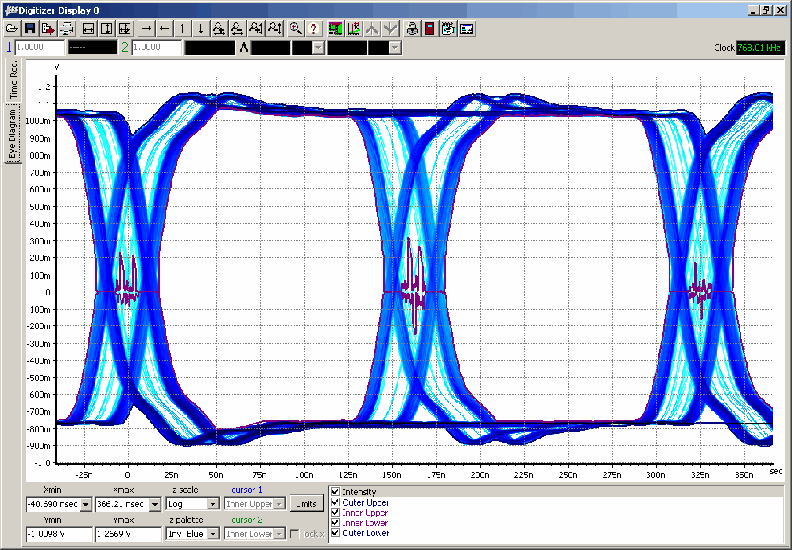
An optional 80 MHz transient digitizer (opt. 01) provides additional digital audio carrier analysis. Operating on a record of up to 2M samples, the digitizer computes and displays the time record of the input signal and its jitter, input spectrum, jitter spectrum, and the probability distributions of the input and jitter amplitudes as well as the pulse width and pulse rate. Full color eye-diagrams can be generated allowing easy testing against user-configurable eye limits.
Automation and Programming
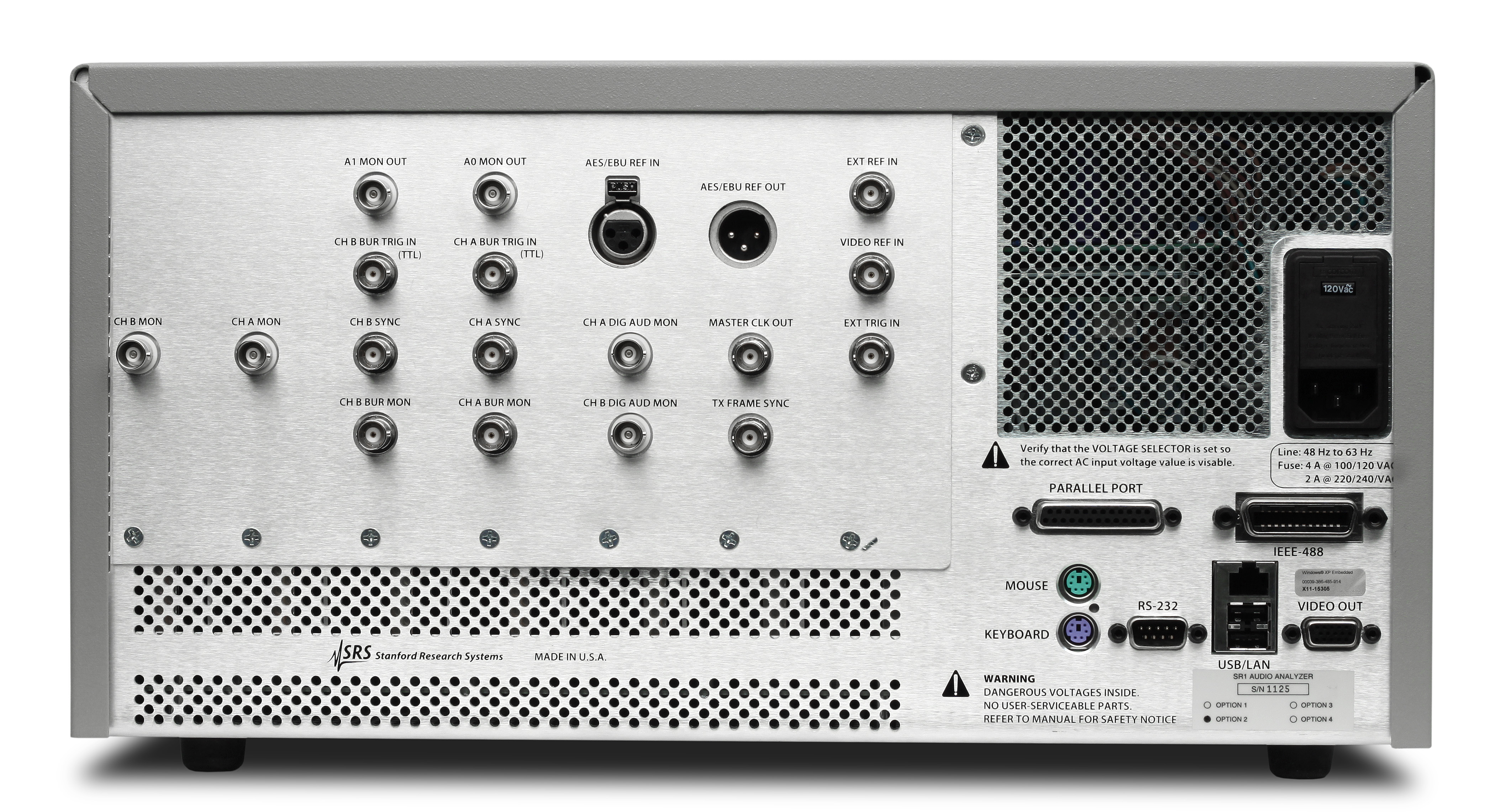
SR1 offers unprecedented flexibility for user scripting and remote programming. On-board scripts can be written in VBScript, Jscript, or Python with full access to all of the instrument’s capabilities as well as the ability to create simple user-interfaces for running tests. SR1 has a complete hierarchical GPIB command set, and GPIB commands can be sent over the standard IEE-488 interface, RS-232 port, or over the Ethernet on a TCP/IP network (VXI-11). Finally, SR1 has a complete COM interface allowing instrument operation to be automated from any COM capable application such as Visual Basic, LabView, or Microsoft Office.
Learning Mode
Learning mode is a powerful tool for quickly creating scripts without detailed knowledge of the programming environment. SR1 creates a script by recording each keystroke or user operation, and then converts the script to a VB script of Jscript program. These programs can be saved and edited like any other script, then run in the future.

![]()
| SR1 Audio Analyzer | |
| Analog Signal Generator | |
| General Characteristics | |
| Amplitude Range (rms) | 1 µV to 28.3 V (balanced) 1 µV to 14.1 V (unbalanced) |
| Amplitude Accuracy | ±0.5 % (±0.043 dB) at 1 kHz |
| Frequency Range | |
| Hi BW DAC | 10 Hz to 200 kHz |
| Hi Res DAC | 10 Hz to 0.45Fs (Fs: 128 kHz or 64 kHz fixed, 24 kHz to 216 kHz adj.) |
| Frequency Accuracy | ±0.0005 % (5 ppm) |
| Frequency Resolution | <Fs/224 |
| Output Configuration | Balanced Ground, Balanced Float, Unbalanced Ground, Unbalanced Float, Common Mode Test |
| Source Impedance | 50 Ω, 150 Ω, 600 Ω (balanced) 25 Ω, 75 Ω, 600 Ω (unbalanced) |
| Max. Power (600 Ω load) | |
| Balanced | 30.5 dBm |
| Unbalanced | 24.9 dBm |
| Float Voltage | ±40 V |
| Crosstalk | |
| 10 Hz to 20 kHz | -125 dB |
| >20 kHz | -100 dB |
| Waveforms | |
| Low Distortion Sine | |
| Flatness (relative to 1 kHz) | |
| 20 Hz to 20 kHz | ±0.020 dB (typ. ±0.012 dB) |
| 10 Hz to 64 kHz | ±0.025 dB |
| 10 Hz to 200 kHz | ±0.05 dB |
| Residual THD+N | |
| 1 kHz, 4 Vrms | -112 dB (22 kHz BW) |
| 20 Hz to 20 kHz | -106 dB + 1 µV (22 kHz BW) -100.5 dB + 1.7 µV (80 kHz BW) -97 dB + 2.5 µV (200 kHz BW) |
| 10 Hz to 100 kHz | -89 dB + 2.5 µV (200 kHz BW) |
| Regular Sine | |
| Flatness (rel. to 1 kHz, amplitude ≤4 Vrms) | |
| 20 Hz to 20 kHz | ±0.008 dB (typ. ±0.003 dB) |
| 10 kHz to 64 kHz | ±0.02 dB |
| 10 Hz to 200 kHz | ±0.03 dB |
| Residual THD + N (Hi BW DAC) | |
| 1 kHz | -86 dB (22 kHz BW) |
| 22 Hz to 20 kHz | -85 dB + 1 µV (22 kHz BW) -84.5 dB + 1.7 µV (80 kHz BW) -82 dB + 2.5 µV (200 kHz BW) |
| 10 Hz to 100 kHz | -77 dB + 2.5 µV (200 kHz BW) |
| Residual THD+N (Hi Res DAC, Fs = 128 kHz) | |
| 1 kHz | -99 dB (22 kHz BW) |
| 22 Hz to 20 kHz | -98 dB + 1 µV (22 kHz BW) |
| 20 Hz to 57.6 kHz | -96.5 dB + 1.4 µV (57.6 kHz BW) |
| Residual THD+N (Hi Res DAC, Fs = 64 kHz) | |
| 1 kHz | -106 dB (22 kHz BW) |
| 22 Hz to 20 kHz | -101 dB + 1 µV (22 kHz BW) |
| Phased Sines | 0 to 360°, 0.001° resolution |
| IMD | SMPTE/DIN, CCIF/DFD, DIM/TIM |
| Noise | White, Pink, Filtered White/Pink, USASI |
| Multitone | 1 to 50 tones |
| MLS | Repetition rates from 28 to 220 |
| FFT Chirp | Equal power in each FFT bin |
| Log-sine chirp | Swept-sine with log increasing frequencies |
| Square | 10 Hz to 50 kHz frequency range |
| Ramp | Fs/N frequency range (N≥20) |
| Arbitrary | 256 Samples to 136k Samples |
| Polarity | 10 Hz to Fs/4 frequency range |
| Constant (Offset) | DC to 20 Vp (unbal) / 40 Vp (bal) |
| Bursts | |
| Burst Types | Timed, externally triggered, externally gated, synchronous sine, shaped |
| Digital Audio Signal Generator | |
| Digital Audio Carrier Characteristics | |
| Output Amplitude | |
| Balanced | |
| Range | 16 mV to 10.2 V (110 Ω load) |
| Accuracy | ±10 % + 80 mV |
| Unbalanced | |
| Range | 4 mV to 2.55 V (75 Ω load) |
| Accuracy | ±10 % + 20 mV |
| Output Format | Balanced XLR (AES/EBU), dual-connector XLR, unbalanced BNC (SPDIF-EIAJ),dual-connector BNC, Optical (Toslink) |
| Output Sample Rate | 24 kHz to 216 kHz |
| Sample Rate Accuracy | ±5 ppm |
| Output Impedance | 110 Ω (balanced), 75 Ω (unbalanced) |
| Digital Audio Waveforms | |
| Sine | |
| Frequency Range | 10 Hz to Fs/2 |
| Frequency Resolution | <Fs/224 |
| Flatness | ±0.001 dB |
| Harmonic/Spurious | -148 dB |
| Phased Sine | 0 to 360° range, 0.01° resolution |
| Square | 10 Hz to Fs/2 frequency range |
| IMD | SMPTE/DIN, CCIF/DFD, DIM/TIM |
| Noise | White, Pink, Filtered White/Pink, USASI |
| MLS | Repetition rates from 28 to 220 |
| Ramp | Fs/N frequency range (N≥20) |
| Arbitrary | 256 Samples to 136k Samples |
| FFT Chirp | Equal power in each FFT bin. |
| Log-swept sine chirp | Swept-sine with log increasing frequencies |
| Polarity | 10 Hz to Fs/4 frequency range |
| Bursts | |
| Burst waveforms | All allowed waveforms |
| Burst types | Timed |
| Digital Test Waveforms | Digital Constant, Count, Rotating Bits, Staircase, J-Test |
| Dither | None, triangle and rectangular probability distribution |
| Digital Audio Carrier Impairments | |
| Jitter | |
| Waveforms | Sine, square, uniform noise, BP filtered noise, chirp |
| Frequency Range | 2 Hz to 200 kHz |
| Amplitude Range | 0 UI to 13 UI |
| Normal Mode Noise | |
| Amplitude Range | |
| Unbalanced | 0 to 637 mVpp |
| Balanced | 0 to 2.55 Vpp |
| Common Mode Sine | |
| Amplitude Range | 0 to 20 Vpp (balanced only) |
| Frequency Range | 10 Hz to 100 kHz |
| Cable Simulation | Simulates 100 m of digital audio cable |
| Variable Rise Time | 5 ns to 400 ns |
| Signal Measurements | |
| General Analog Input Characteristics | |
| Input Range (rms) | 62.5 mV to 160 V |
| Input Configuration | XLR, BNC, Generator Monitor, Digital Audio Common Mode |
| Input Impedance | |
| Balanced | 200 kΩ / 95 pF |
| Unbalanced | 100 kΩ / 185 pF |
| Input Termination (bal) | 300 Ω, 600 Ω, 200 kΩ |
| Crosstalk | |
| 10 Hz to 50 kHz | ≤-140 dB |
| >50 kHz | ≤-135 dB |
| Hi BW ADC | |
| Type | 16-bit sigma-delta |
| Sampling Frequency | 512 kHz |
| Frequency Range | DC to 228 kHz |
| Hi Res ADC | |
| Type | 24-bit sigma-delta |
| Sampling Frequency | 128 kHz or 64 kHz (fixed), 24 kHz to 216 kHz (adj.) |
| Frequency Range | DC to 0.45Fs |
| General Digital Input Characteristics | |
| Input Format | Balanced XLR (AES/EBU), dual-connector XLR, unbalanced BNC (SPDIF-EIAJ), dual-connector BNC, Optical (Toslink) |
| Input Sample Rate | 24 kHz to 216 kHz |
| Input Impedance | Hi Z or 110 Ω (balanced) Hi Z or 75 Ω (unbalanced) |
| Analog Signal Meters | |
| RMS Level Meter | |
| Accuracy (1 kHz ref) | ±0.5 % (±0.043 dB) |
| Flatness (1 kHz ref, amplitude less than 4Vrms) | |
| 20 Hz to 20 kHz | <±0.008 dB (typ. <±0.003 dB) |
| 10 Hz to 64 kHz | <±0.02 dB |
| 10 Hz to 200 kHz | <±0.03 dB |
| Frequency Meter | |
| Range | 8 Hz to 300 kHz |
| Accuracy | Timebase error ± (2 ppm + 10 mHz) |
| Phase Meter | |
| Accuracy | ±1.0° |
| Digital Signal Meters | |
| Frequency Meter | 10 Hz to 0.45Fs, ±100 ppm accuracy |
| Phase Meter | ±0.05° accuracy (f≥50 Hz) |
| Analyzers (Analog and Digital Audio) | |
| Time Domain Analyzer | |
| Measurements | Amplitude, amplitude ratio, THD+N, THD+N ratio, SINAD, Crest Factor |
| Analog Inputs | |
| Amplitude Accuracy | ±0.5 % (±0.043 dB) |
| Flatness (1 kHz ref) | |
| 50 Hz to 20 kHz | <±0.008 dB (typ. ±0.003 dB) |
| 20 Hz to 64 kHz | <±0.02 dB |
| 10 Hz to 200 kHz | <±0.05 dB |
| Residual Noise (62.5 Vrms input range, shorted input) | |
| Hi Res ADC (Fs=128 kHz) | |
| 22 Hz to 22 kHz | <-117.5 dBu |
| 22 kHz to 57.6 kHz | <-115 dBu |
| A-Weighted | <-120 dBu |
| Hi BW ADC | |
| 22 Hz to 22 kHz | <-118 dBu |
| 22 Hz to 80 kHz | <-113 dBu |
| 22 Hz to 200 kHz | <-110 dBu |
| A-Weighted | <-120 dBu |
| Residual THD+N | |
| Hi Res ADC (Fs=128 kHz) | |
| 1 kHz, 4 Vrms | -111 dB (22 kHz BW) |
| 20 Hz to 20 kHz | -107 dB + 0.8 µV (22 kHz BW) -101 dB + 1.3 µV (57.6 kHz BW) |
| Hi Res ADC (Fs=64 kHz) | |
| 1 kHz, 4 Vrms | -111 dB (22 kHz BW) |
| 20 Hz to 20 kHz | -107 dB + 0.8 µV (22 kHz BW) |
| Hi BW ADC | |
| 1 kHz, 4 Vrms | -113 dB (22 kHz BW) |
| 20 Hz to 20 kHz | -109 dB + 0.8 µV (22 kHz BW) -102 dB + 1.5 µV (80 kHz BW) -98 dB + 2.5 µV (200 kHz BW) |
| 10 Hz to 100 kHz | -91 dB (200 kHz BW) |
| Digital Inputs | |
| Amplitude Accuracy | ±0.001 dB (at 1 kHz) |
| Flatness | ±0.001 dB (15 Hz to 22 kHz) |
| Residual THD+N | -140 dBFS |
| Bandwidth Limiting Filters | |
| Low Pass Filter | 4th order Butterworth, adj. from Fs/40 to 0.45Fs, 20 kHz, 40 kHz and 80 kHz fixed elliptical filters per AES17. |
| High Pass Filter | 4th order Butterworth, @22 Hz, 100 Hz, and 400 Hz. 20 kHz, 40 kHz and 80 kHz fixed elliptical filters per AES17. |
| Band Pass Filter | |
| Response | |
| Hi BW ADC | 1/3 Octave, Class II (4-pole) |
| Hi Res ADC | 1/3, 1/6, 1/12, 1/24 Octave, Class III (6-pole) |
| Tuning Range | |
| Hi BW ADC | 10 Hz to 200 kHz |
| Hi Res ADC | 10 Hz to 0.44Fs |
| Tuning Accuracy | ±2.5 % |
| Amplitude Accuracy | ±0.5 % |
| Notch Filter | |
| Tuning Range | |
| Hi BW ADC | 10 Hz to 200 kHz |
| Hi Res ADC | 10 Hz to 0.44Fs |
| Tuning Accuracy | ±2.5 % |
| Response | -3 dB at 0.73Fc and 1.37Fc |
| Amplitude Accuracy | ±0.2 dB (20 Hz to 180 kHz, f<0.5f0 or f>2f0) |
| Weighting Filters | A-wt, C-Msg wt, CCITT, CCIR (weighted, unweighted, & 2 kHz norm) |
| Detector response | RMS, Peak, Quasi-Peak (CCIR-468) |
| Single and Dual-Ch. FFT Analyzers | |
| Frequency Range | |
| Hi BW ADC | DC to 200 kHz |
| Hi Res ADC | DC to 0.45Fs |
| Number of Lines | 256, 512, ... 32k |
| Processing | 40-bit floating point |
| Windows | Blackman Harris, Enhanced Blackman Harris, Hann, Hamming, Equiripple, Flattop, Gaussian, Kaiser, Uniform, Rife Vincent 4, 5 and 10 term |
| Zoom | Span can be narrowed by up to 512x |
| Heterodyne | Narrowed span can be centered anywhere in the measurement range |
| Averaging | Fixed length and continuous |
| Dual-Ch. Measurements | Frequency response, Impulse and Quasi-Anechoic Response, Coherence, Energy Time Curve, Group Delay |
| THD Analyzer | Measures two independent sets of user-selectable harmonics (2x to 14x) |
| IMD Analyzer | SMPTE/DIN, CCIF/DFD, DIM/TIM |
| Histogram Analyzer | Time vs. amplitude, Histogram, PDF, Gaussian fit to PDF |
| Multitone Analyzer | Level, Frequency Response, THD+N, THD, noise, IMD, Crosstalk |
| Digital Audio Carrier Measurements | |
| Measurements | Carrier amplitude, sample rate, jitter amplitude, jitter spectrum |
| Sample Rate | 24 kHz to 216 kHz |
| Sample Rate Accuracy | ±5 ppm |
| Carrier Amplitude Measurements | |
| Balanced (XLR) | ±10 % + 80 mV |
| Unbalanced (BNC) | ±10 % + 20 mV |
| Optical | Displays voltage of Toslink receiver |
| Output to Input Delay | Measures delay from Digital Audio Output or AES11 reference output to Digital Audio Input |
| Range | -12.7 UI to +115.1 UI in seconds |
| Resolution | 60 ns |
| Residual Jitter | |
| 50 Hz to 100 kHz | ≤600 ps |
| Reference | |
| Input Surces | AES11 (24 Hz to 216 kHz), sine or TTL (8 kHz to 32 MHz), video (NTSC/PAL/SECAM) |
| Optional Digitizer (opt. 01) | |
| Sampling Rate | 80 MHz |
| Acquisition Length | 4k, 8k, 16k, 128k, 256k, 512k, 1M, 2M samples |
| Measurements | Input vs. time, jitter vs. time, input spectrum, jitter spectrum, pulse width/rate histograms, jitter probability histogram, eye diagrams |
| General | |
| Computer Interfaces | GPIB, RS-232, Ethernet, COM |
| Video Out | VGA output for driving external monitor |
| Power | <250 W, 90 VACto 264 VAC, 47 Hz to 63 Hz |
| Dimensions | 17" × 8.5 " × 20.25 " (WHD) |
| Weight | 40 lbs. |
| Warranty | One year parts and labor on defects in materials and workmanship |