|
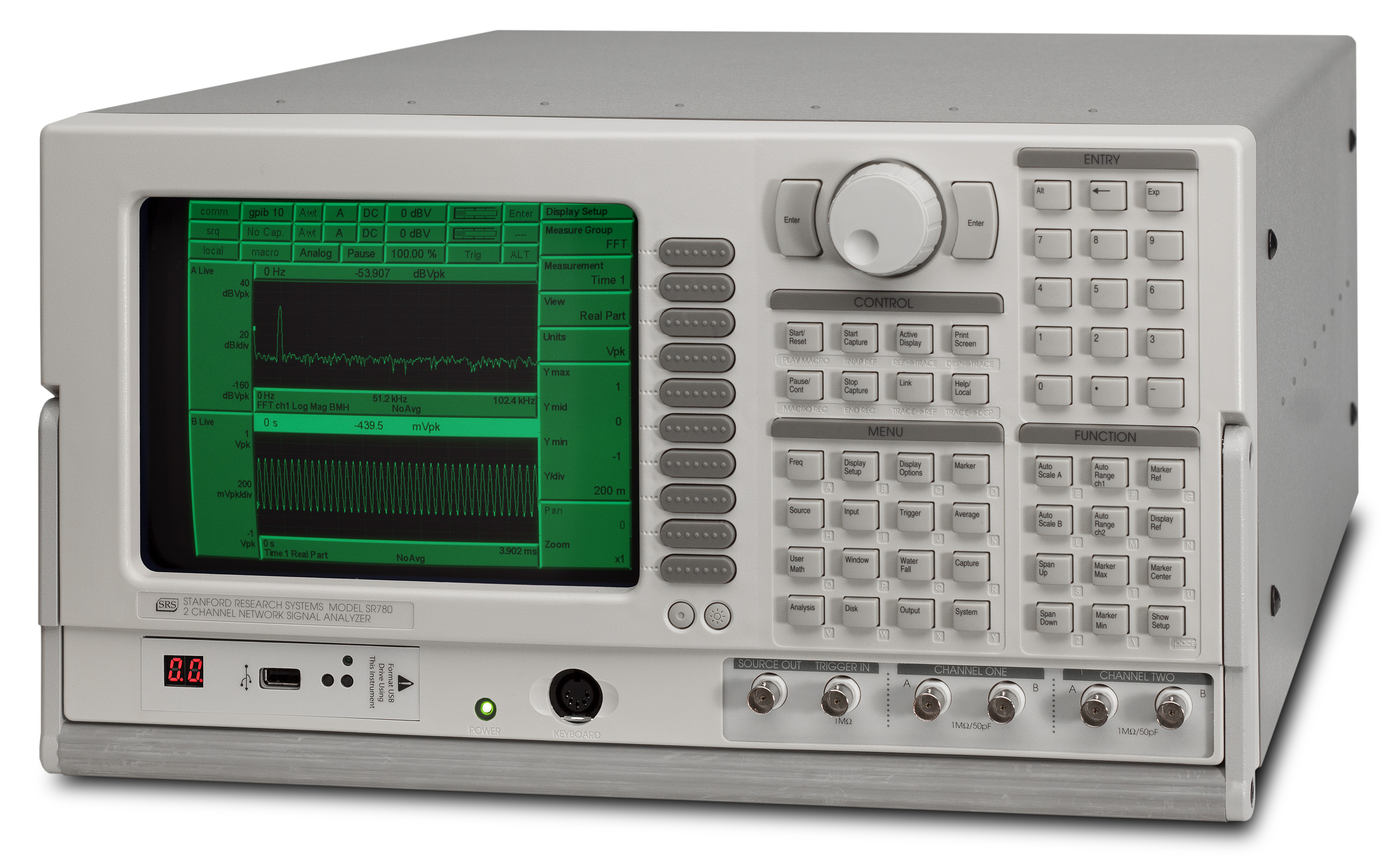
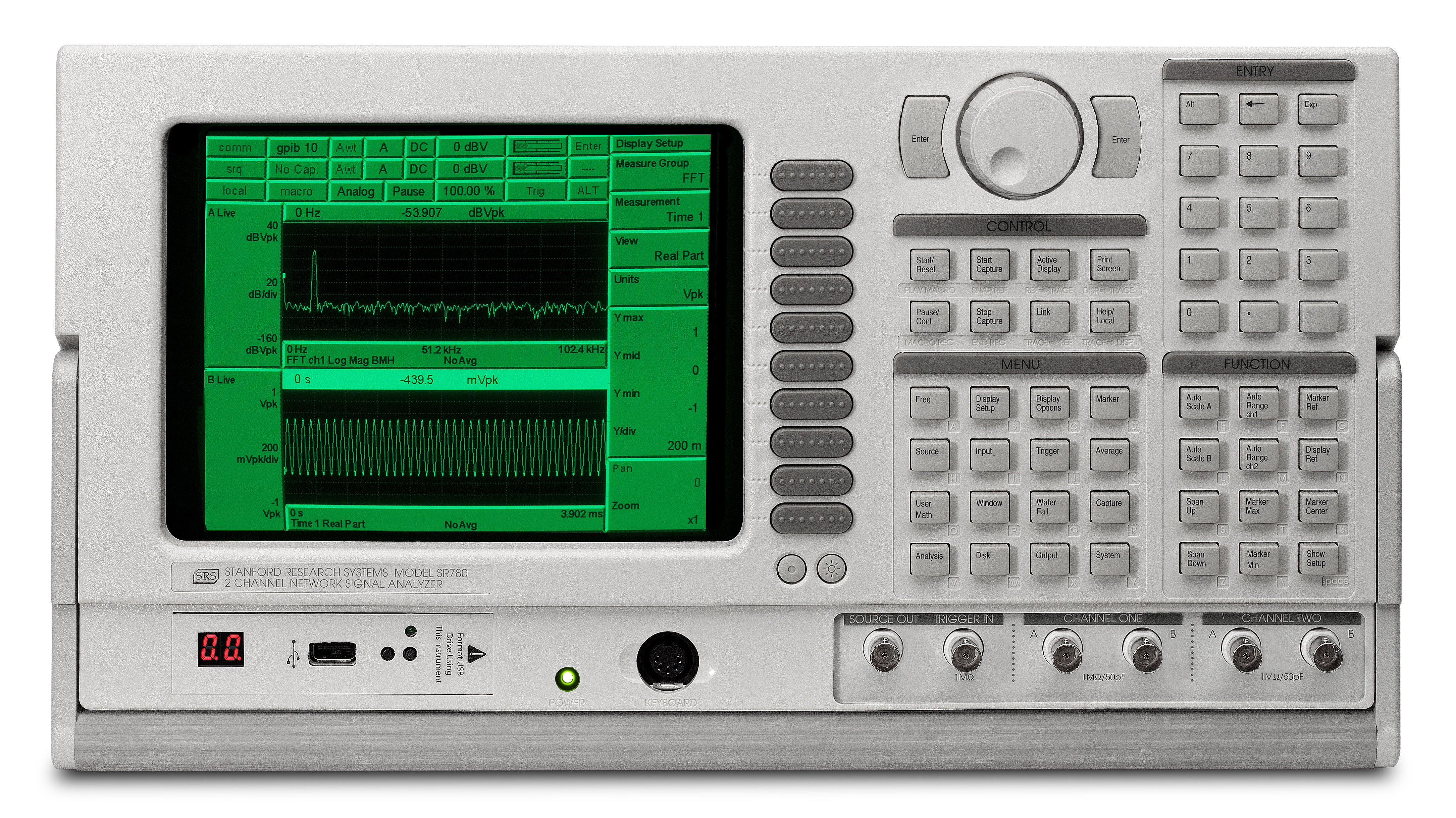
The SR780 Dynamic Signal Analyzer combines high performance and
low cost in a full-featured package. It offers 102.4 kHz dual-channel
FFTs with 90 dB dynamic range, 145 dB dynamic range swept-sine measurements,
real-time ANSI standard octave analysis, waterfall displays and
transient capture for less than half the cost of other similarly
equipped analyzers.
Whether your application involves acoustic measurements, vibration
testing, servo systems or filter design, the SR780s features,
performance and low cost are unmatched.
Spectrum Analysis
The SR780 delivers true two-channel 102.4 kHz FFT performance.
Its fast 32-bit floating-point DSP processor gives the SR780 102.4
kHz real-time rate with both channels selected. Two precision 16-bit
ADCs provide a 90 dB dynamic range in FFT mode. Selectable 100 to
800 line analysis optimizes time and frequency resolution, and you
can zoom in on any portion of the 102.4 kHz range with a frequency
span down to 191 mHz.
The SR780s unique architecture lets the two displays function
independently. You can choose separate frequency spans, starting
frequencies, number of FFT lines, or averaging modes for each display.
So its easy look at a wideband display and zoom in on a specific
feature simultaneously. The SR780 lets you select from two sampling
rates: 256 kHz or 262 kHz, so frequency spans come out in either
a binary (102.4 kHz, 51.2 kHz,...) or decimal (100 kHz, 50 kHz,
25 kHz,...) sequence depending on your requirements.
Flexible Averaging
Several averaging choices are provided. RMS averaging reduces signal
fluctuations, while vector averaging minimizes noise from synchronous
signals. You can choose linear averaging (stable averaging) for
fixed signals, or exponential averaging to track drifting features.
Because the SR780s 102.4 kHz real-time bandwidth lets it take
data seamlessly, vector averaging can be selected for any signal
thats repetitive within the time recordno trigger is
necessary.
Transducer Units
Automatic unit conversion makes translating accelerometer data
easy. Yuo can enter accelerometer conversions directly in V/EU,
EU/V or dB (1 V/EU). The SR780 will display results in units of
meters, inches, mil, g, kg, lbs., N, dynes, pascals, bars, or dBSPL.
Accelerometer data is automatically converted to velocity or displacement
units. Built-in ICP power means you wont need an external
power supply for your accelerometer.
Octave Analysis
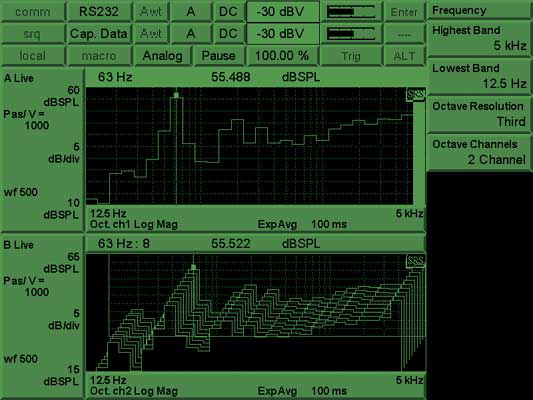
Real-time octave analysis at frequencies up to 40 kHz (single channel)
or 20 kHz (two-channel), is standard in the SR780. Octave analysis
is fully compliant with ANSI and IEC standards. Full octave, 1/3
octave and 1/12 octave analysis are all available. Switchable analog
A-weighting filters as well as built-in user math A-, B-, and C-weighting
functions are included. Octave averaging choices include exponential
time averaging, linear time averaging, peak hold, and equal confidence
averaging. IEC 651-1979 Type 0 compliant peak hold, impulse, fast
and slow sound level measurements are all calculated.
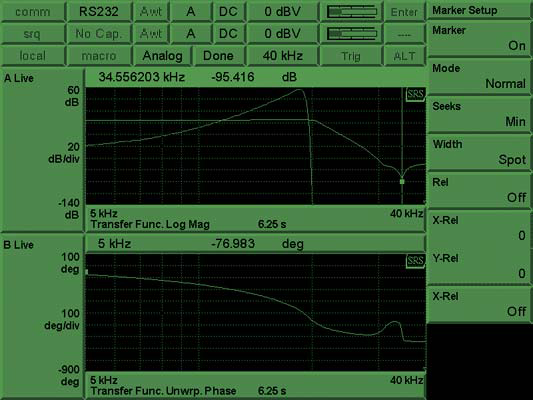
Swept-Sine Analysis
Swept-sine analysis is used for measurements involving high dynamic
range or wide frequency intervals, and is a standard feature of
the SR780. Selectable auto-ranging optimizes the input range at
each point in the measurement, providing up to 145 dB of dynamic
range. Auto-ranging can be used with source auto-leveling to maintain
a constant input or output level at the device under test. To ensure
the fastest sweeps possible, auto-resolution can also be selected,
providing a variable scan speed tailored precisely to the signal
being measured.
User Math
User-defined math functions are available in all measurement groups.
Equations are created from time or frequency data, stored files,
constants, or a rich array of supplied operations including the
arithmetic functions, FFT, inverse FFT, jΩ, d/dΩ, exp,
ln x and many others. Unlike many analyzers, the SR780's
measurement rate isn't reduced when user math is selected. For instance,
the function exp(ln(conj(Average(FFT2/FFT1))) can be calculated
with a 50 kHz real-time bandwidth.
Source
Six source types are available: low distortion (-80 dBc) single
or two-tone sine waves, chirp, white noise, pink noise, and arbitrary
waveforms. The chirp and noise sources can both be bursted to provide
a source thats active only over a selected portion of the
time record for FFT measurements, or to provide an impulsive noise
source for acoustic measurements. The digitally synthesized source
provides output levels from 0.1 mV to 5 V, and delivers up to 100
mA of current.
Arbitrary waveform capability is standard on the SR780. The arbitrary
source can be used to playback a section of a captured waveform,
play a selected FFT time record or upload a custom waveform.
Capture
The SR780 comes standard with 2 Msamples of standard capture memory.
Waveforms can be captured at 262 kHz or any sub-multiple of 262
kHz, allowing you to select the sample rate and capture length thats
right for your data. Once captured, any portion of the signal can
be played back in FFT or Octave mode. The convenient "AutoPan"
feature lets you display the measurement results synchronously with
the corresponding portion of the capture buffer to easily identify
important features. An optional memory expansion module lets you
extend the SR780s capture depth to 8 Msamplesthats
almost 30 seconds of capture at the maximum sampling rate.
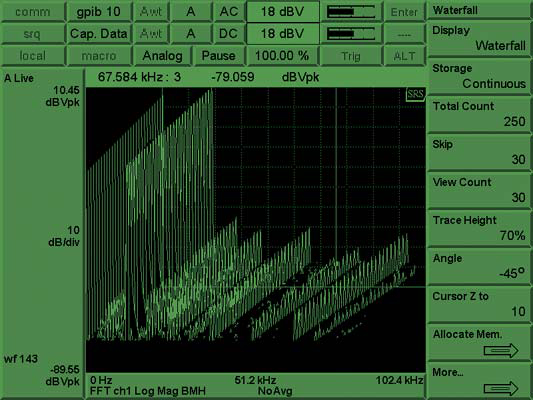
Waterfall
All Octave and FFT Measurements can be stored in the SR780s
2k-deep waterfall buffers. Waterfall storage is selectable as every
nth time record for FFT measurements,
or you can select a storage interval in seconds (down to 4 ms) for
octave measurements. While displaying waterfalls, you can adjust
the skew angle to reveal important features, or change the baseline
threshold to eliminate low-level clutter. Any z-axis slice or x-axis
record can be saved to disk or displayed separately for individual
analysis.
Analysis
The SR780 includes a wide variety of built-in analysis features.
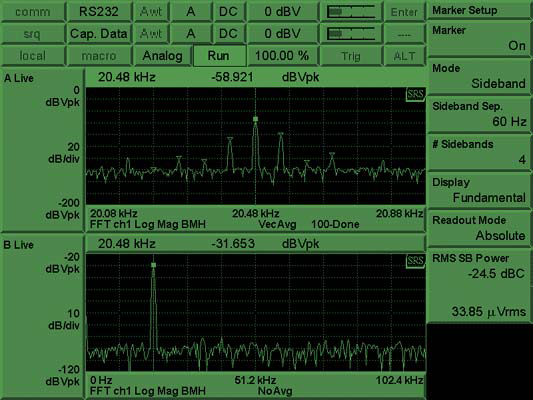
Marker analysis lets you use the marker to easily measure the power
contained in the harmonics, sidebands, or within a given band of
frequencies. Important signal information such as THD, THD+N, sideband
power relative to carrier, and total integrated power are calculated
in real time and displayed on the screen. Marker statistics quickly
calculate the maximum, minimum, mean and standard deviation of data
at any point in the display.
A data table feature lets you display up to 100 selected data points
in tabular format. Limit tables allow you to define up to 100 upper
and lower limit segments in each display for GO/NO-GO testing. Data
and limit table definitions can also be saved and recalled from
disk for quick setup.
Output
The SR780's built-in 3.5" disk drive, computer interfaces
(GPIB and RS-232) and printer port provide flexibility when saving,
printing and exporting data. Data can be saved in binary or ASCII
formats and displays can be printed/plotted to any of the ports
or the disk drive. Supported formats include PCX, GIF, PCL (LaserJet
and DeskJet), dot-matrix, postscript and HP-GL. An annotation
editor lets you add text, time, date and filenames to any portion
of the plot. Utilities are included to translate your HP SDF files
into SR780 format.
Help
Full, context-sensitive help screens for all SR780 features mean
you will rarely have to refer to a printed manual. Hypertext links
let you quickly switch between related help pages or instantly reference
the remote command corresponding to any SR780 function. Use the
help index to quickly locate help on any topic, jump to the online
troubleshooting guide, browse a complete listing of the SR780s
specifications, or examine a comprehensive description the SR780s
remote commands... all from the front panel.
Measurements - FFT Group
FFT, Time Record, Windowed Time, Time Capture,
Transfer Function, Cross Spectrum, Coherence, Cross-Correlation,
Auto-Correlation, Orbit, User Math
Measurements - Octave Analysis Group
1/1, 1/3, 1/12 Octave, Time Capture, User Math, Leq,
Impulse, Total Power
Measurements - Swept-Sine Group
Spectrum, Transfer Function, Cross Spectrum, User Math
FFT Resolution
100, 200, 400, 800 lines
Views
Linear Magnitude, Log Magnitude, Magnitude Squared, Real Part, Imaginary
Part, Phase, Unwrapped Phase, Nichols, Nyquist
Units
V, V2, V2/Hz,
V/√Hz, meters, inches, mils, g, kg, lbs., N, dynes, pascals,
bars, SPL, user-defined engineering units (EUs)
Displays
Single, Dual, Waterfall with Skew, Zoom and Pan
Averaging
RMS, Vector, Peak Hold, Linear, Exponential, Equal Confidence (Octave),
Preview Time Record
Triggering
Continuous, Internal, External (Analog or TTL), Source, Auto/Manual
Arming
Source Outputs
Sine, Two-Tone, Swept-Sine, White/Pink Noise, Burst Noise, Chirp,
Burst Chirp, and Arbitrary
Windows
Hanning, Blackman-Harris, Flat-Top, Kaiser, Force/Exponential, User-Defined,
+/-T/2, +/-T/4, T/2, Uniform
User Math
+, -, ×, /, Conjugate, Magnitude/Phase, Real/Imaginary, Sqrt,
FFT, Inverse FFT, jΩ, Log, Exp, d/dx, Group Delay,
A-, B-, C-Weighting, x/x-1
Analysis
Harmonic, Band, Sideband, THD, THD + N, Limit Test with Pass/Fail,
Data Table, Exceedance, Statistics
Time Capture
Captures time data for later analysis (FFT or Octave). Up to 2 Msamples
(8 Msamples optional) of data can be saved.
Storage
3.5", 1.44 Mbyte, DOS formatted disk. Save data and setups.
Hard Copy and Interfaces
Print to dot matrix or PCL (LaserJet and DeskJet) printers. Plot
to HP-GL or postscript plotters. Print/plot on-line (RS-232 serial,

Centronics parallel or IEEE-488.2) or to disk file. EPS, GIF, PCX
graphic formats also available for disk storage.
|