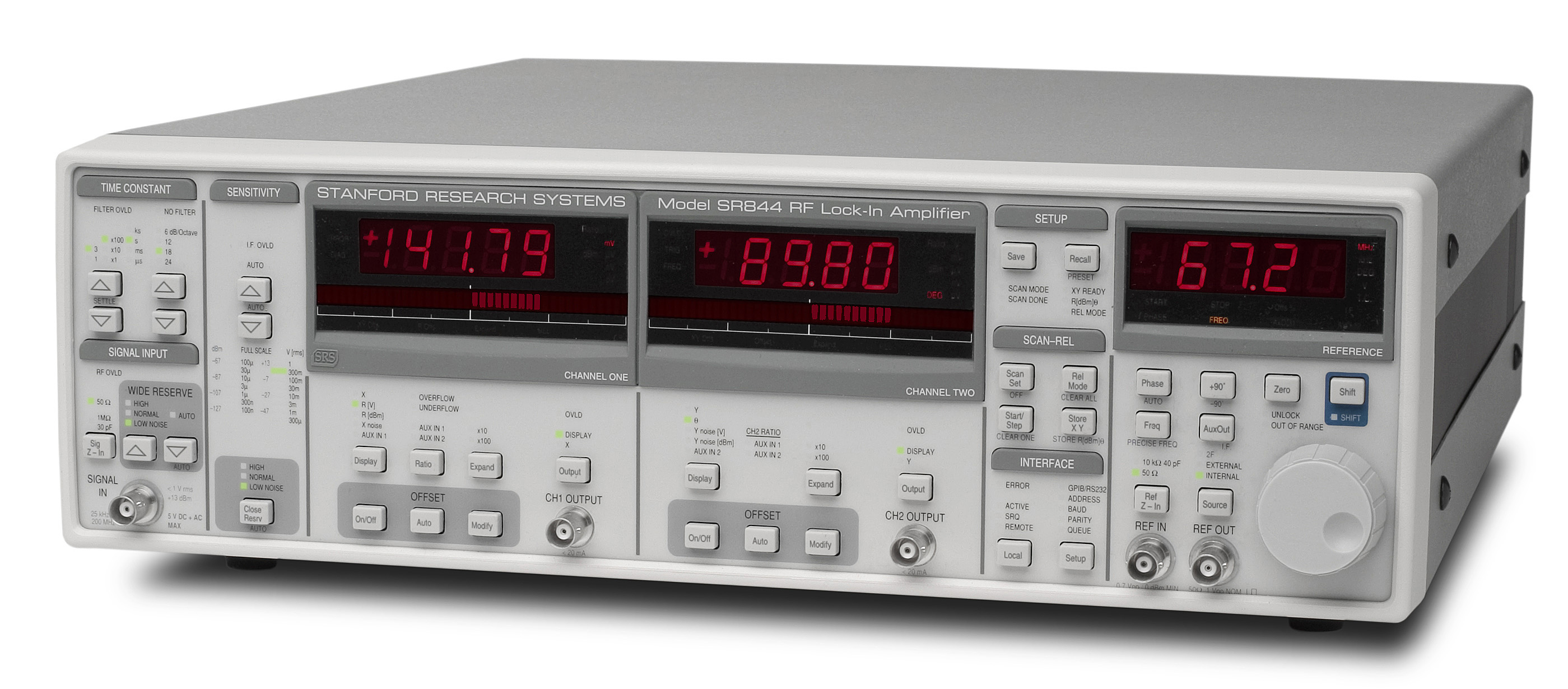
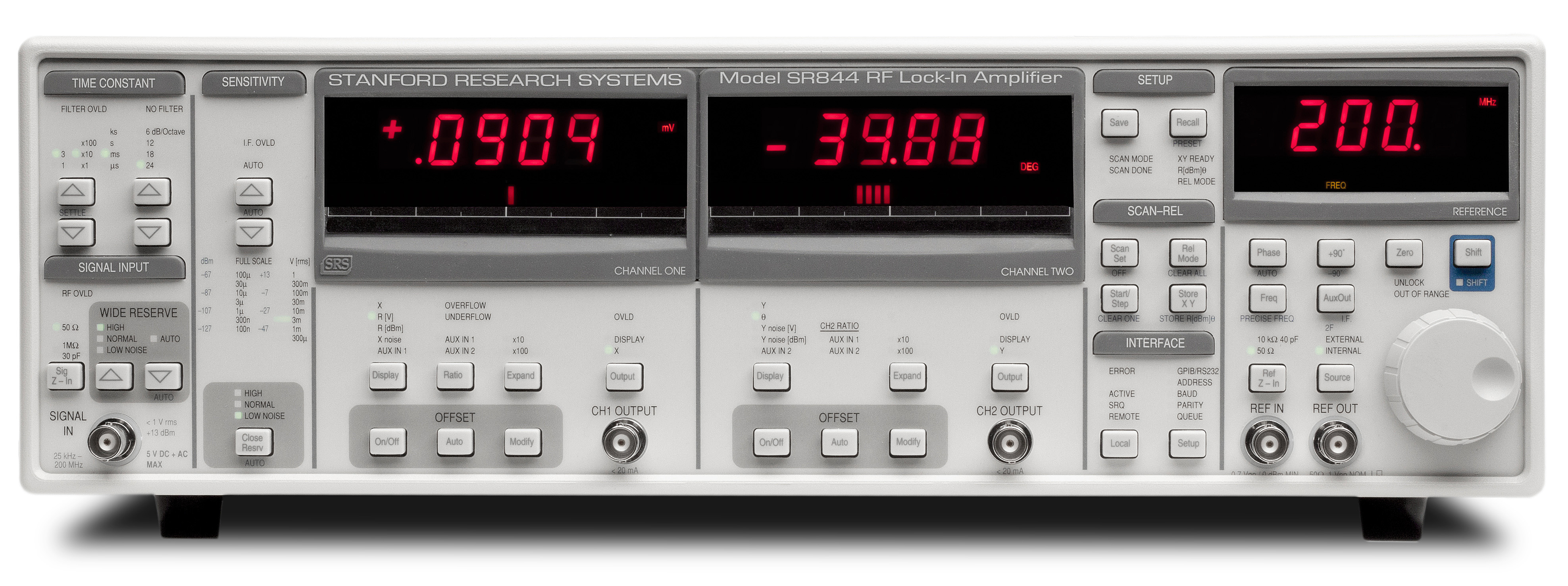
The SR844 is the widest bandwidth lock-in amplifier available from SRS. It provides uncompromised performance with a frequency range of 25 kHz to 200 MHz and up to 80 dB of drift-free dynamic reserve. The SR844 includes the many features, ease of operation, and programmability that you've come to expect from SRS DSP
Digital Technology
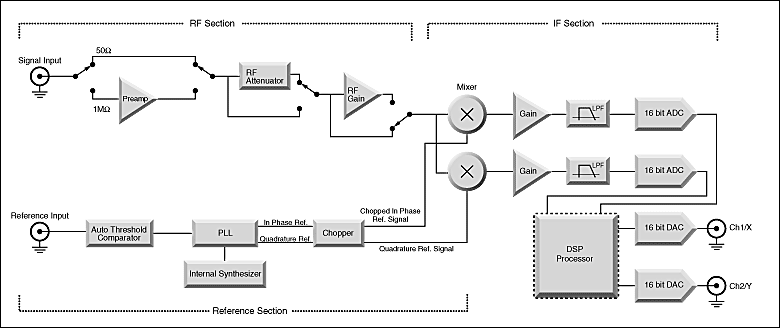
The SR844 uses the same advanced DSP technology found in the SR850, SR830 and SR810
Signal Input
The SR844 has both 50 Ω and 1 MΩ inputs. The 1 MΩ input is used with high source impedances at low frequencies, or with a standard 10× scope probe. The 50 Ω input provides the best RF signal matching.
Reference
The SR844 offers both external and internal reference operation. In both cases, the entire 25 kHz to 200 MHz frequency range is covered without any manual range selection. The external reference input has an auto-threshold feature which locks to sine, square or pulsed signals. The internal reference is digitally synthesized and is adjustable with
Harmonic detection of the 2F component is available for both internal and external reference modes.
A reference output (1.0 Vpp square wave into 50 Ω) which is phase synchronous with the
Output Filters
Time constants from 100 µs to 30 ks can be selected with a choice of 6, 12, 18 or 24 dB/oct rolloff.
Ease of Operation
The SR844 is easy to use. All instrument functions are set from the front-panel keypad, and the knob is used to quickly adjust parameters. Up to nine different instrument configurations can be stored in non-volatile memory for fast, reliable instrument setup. Standard
Useful Features
Auto-functions allow parameters that are frequently adjusted to be set automatically. Sensitivity, dynamic reserve, phase and offset are each quickly optimized with a simple key stroke.
The offset and expand features are useful for evaluating small fluctuations in your signal. The input is nulled with the auto-offset function, and output expand increases the resolution by up to 100×.
Ratio mode is used to normalize the signal to an externally applied analog voltage. It is useful to eliminate the effect of source intensity fluctuations.
Transfer function measurements can be easily made from the front panel by a programmable scan of up to 11 frequencies. Setups and offsets are recalled at each frequency in the scan.
Analog Inputs and Outputs
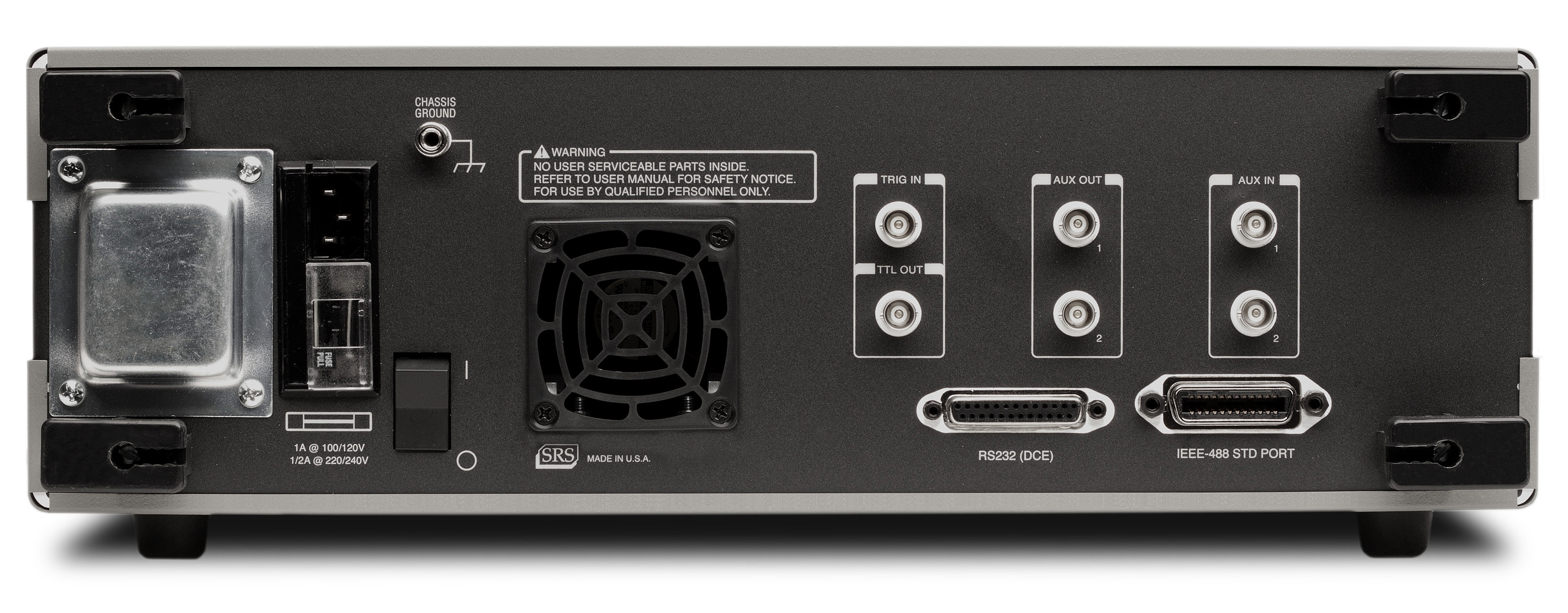
The two displays each have a user-defined output for measuring X, Y, R, R(dBm), Θ, and
In addition, there are two general purpose analog inputs. These are
Internal Memory
The SR844 has two 16,000 point memory buffers for recording the time history of each measurement display at rates up to 512 samples/s. Data may be transferred from the buffers using either interface. A trigger input is also provided to synchronize data recording with external events.