



 (408) 744-9040
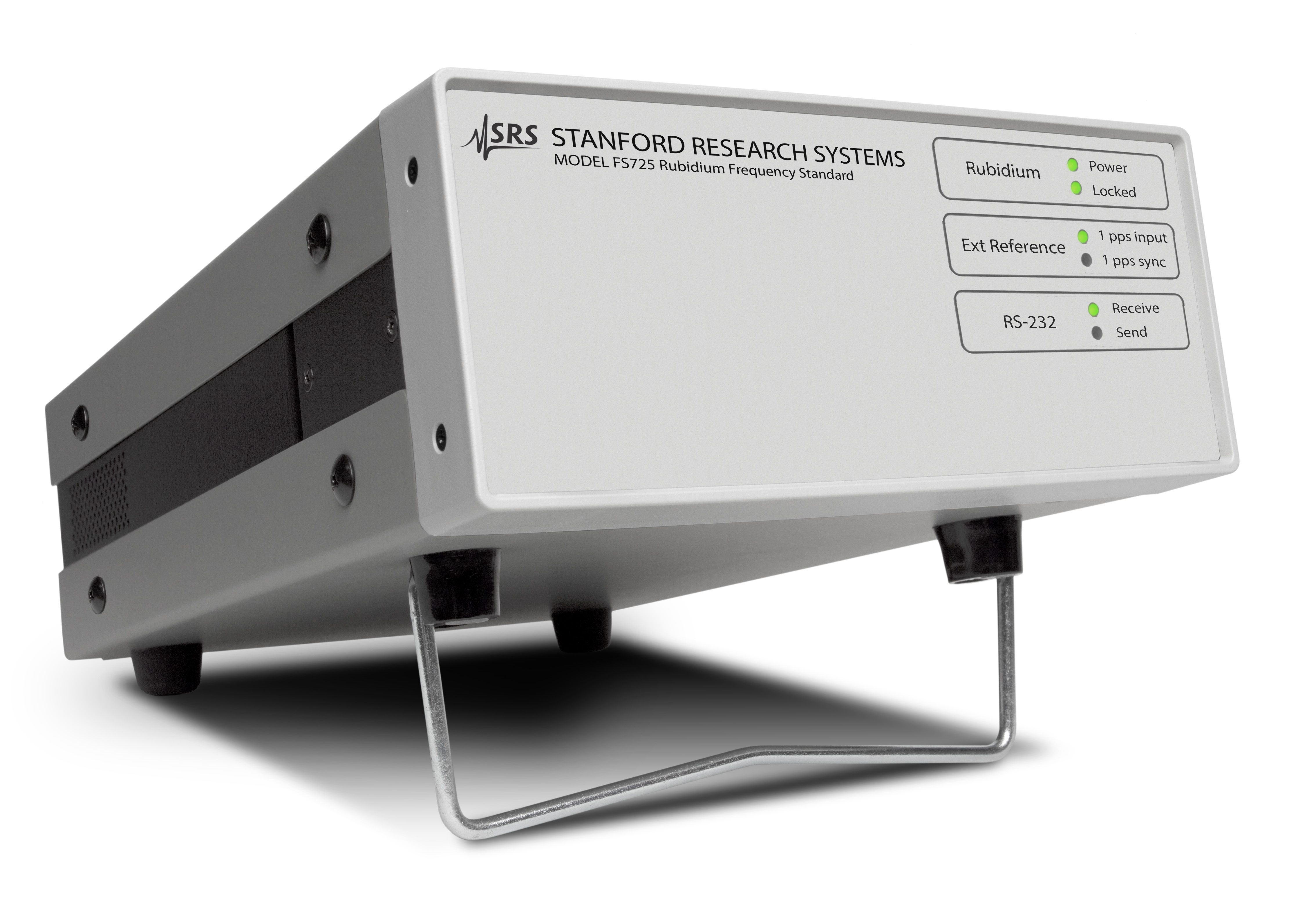
FS725 Rubidium Frequency Standard

|
The FS725 integrates a rubidium oscillator (SRS model PRS10), a low noise universal AC power supply, and distribution amplifiers in a compact half-width 2U chassis. It provides stable and reliable performance, with an estimated 20 year aging of less than |
FS725 Rubidium Frequency Standard
FS725 Rubidium Frequency Standard
FS725 10 MHz Rb Frequency Standard
FS725 Rb Frequency Std.
The FS725 integrates a rubidium oscillator (SRS model PRS10), a low noise universal AC power supply, and distribution amplifiers in a compact half-width 2U chassis. It provides stable and reliable performance, with an estimated 20 year aging of less than
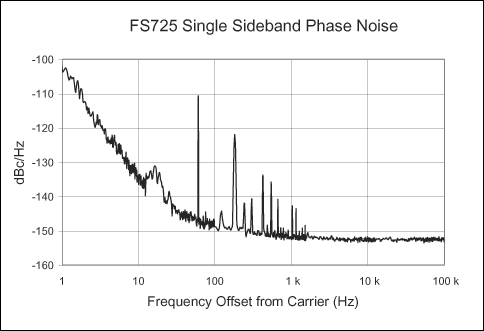
There are two 10 MHz and one 5 MHz outputs with exceptionally low phase noise of
FS725 Single Sideband Phase Noise
|
Up to three internal distribution modules can be added to the FS725. Each module has four 10 MHz outputs, one 5 MHz output, and one 1 pps output, all with the same low phase noise, harmonic distortion and jitter.
An RS-232 interface allows direct communication with the rubidium oscillator. Using the provided Windows software, you can easily monitor and control 1 pps timing, and determine the instrument's operational status.
There are two alarm relays that indicate the status of the rubidium oscillator lock state and synchronization to an external 1 pps input. The relays are SPDT, providing both
FS725 Specifications |
|
Output |
|
| Output frequencies | 10 MHz sine, 5 MHz sine, 1 pps pulse (10 µs wide) |
| Amplitude | 0.5 Vrms, ±10 % |
| 1 pps pulse amplitude | 2.5 V into 50 Ω, 5 V into high-impedance loads |
| Phase noise (SSB) | <-130 dBc/Hz (10 Hz) <-140 dBc/Hz (100 Hz) <-150 dBc/Hz (1 kHz) <-155 dBc/Hz (10 kHz) |
| Spurious | <-100 dBc (100 kHz BW) |
| Harmonics | <-40 dBc |
| Accuracy at shipment | ±5 × 10-11 |
| Aging (after 30 days) | |
| Monthly | <5 × 10-11 <2.5 × 10⁻¹¹ (at shipment) with opt. C |
| Yearly | <5 × 10⁻¹⁰ |
| 20 years (typ.) | 5 × 10⁻⁹ |
| Short term stability (Allan variance) |
<2 × 10-11 (1 s) <1 × 10-11 (10 s) <2 × 10-12 (100 s) |
| Holdover | 72 hour Stratum 1 level (1 × 10-11) |
| Frequency retrace | ±5 × 10-11 (72 hrs. off, then 72 hrs. on) |
| Settability | <5 × 10-12 |
| Trim range | ±2 × 10⁻⁹ (0 to 5 VDC) ±0.5 ppm (via RS-232) |
| Warm-up time | <6 minutes (time to lock) <7 minutes (time to 1 × 10⁻⁹) |
Front-Panel Indicators |
|
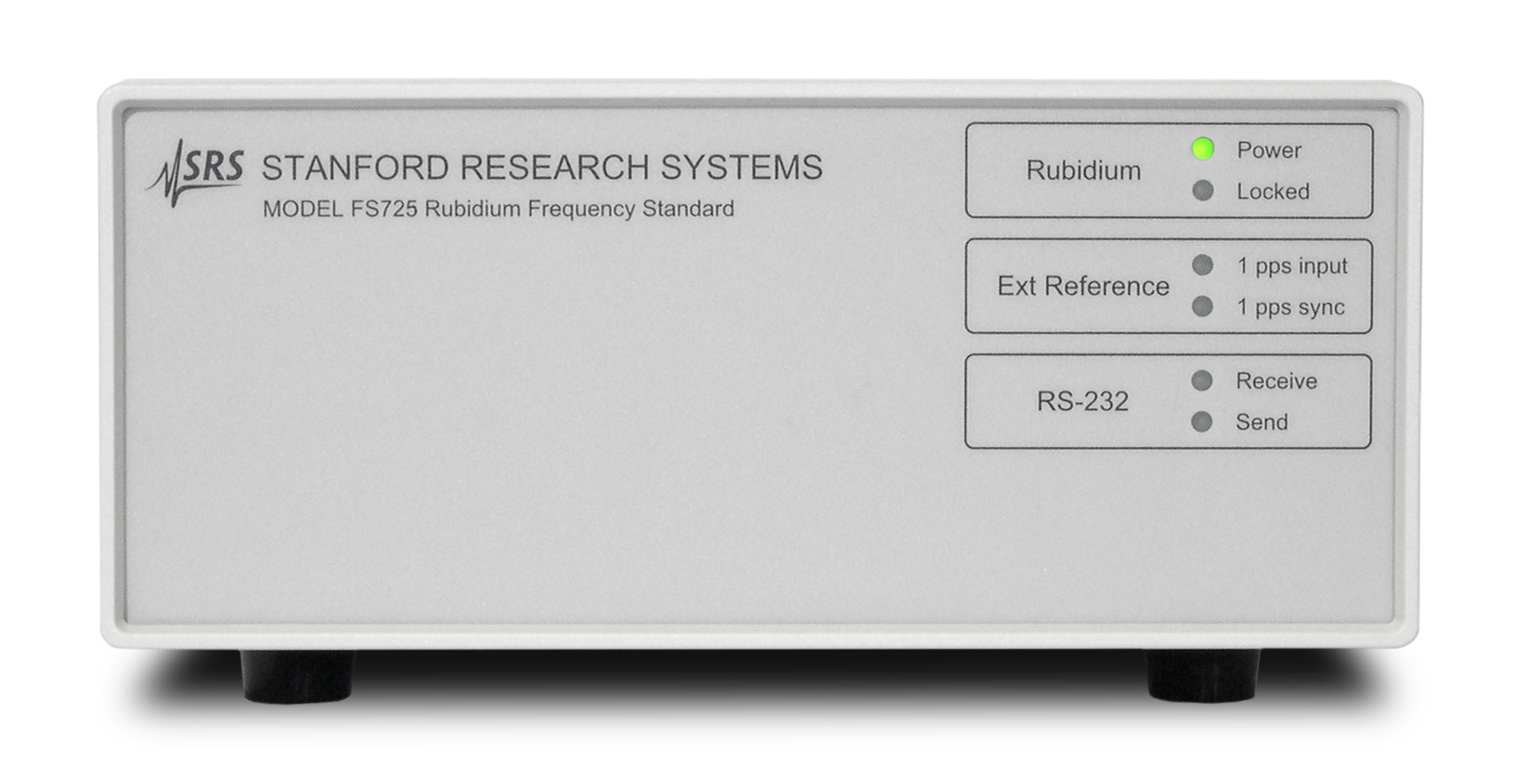
| Power | "On" when AC power is applied |
| Locked | "On" when frequency is locked to rubidium |
| 1 pps input | Blinks with each 1 pps reference input applied to rear panel |
| 1 pps sync | "On" when 1 pps output is synchronized within ±1 µs of 1 pps input |
| Receive | Blinks when RS-232 characters are received by FS725 |
| Send | Blinks when RS-232 characters are sent by FS725 |
Rear-Panel Connections |
|
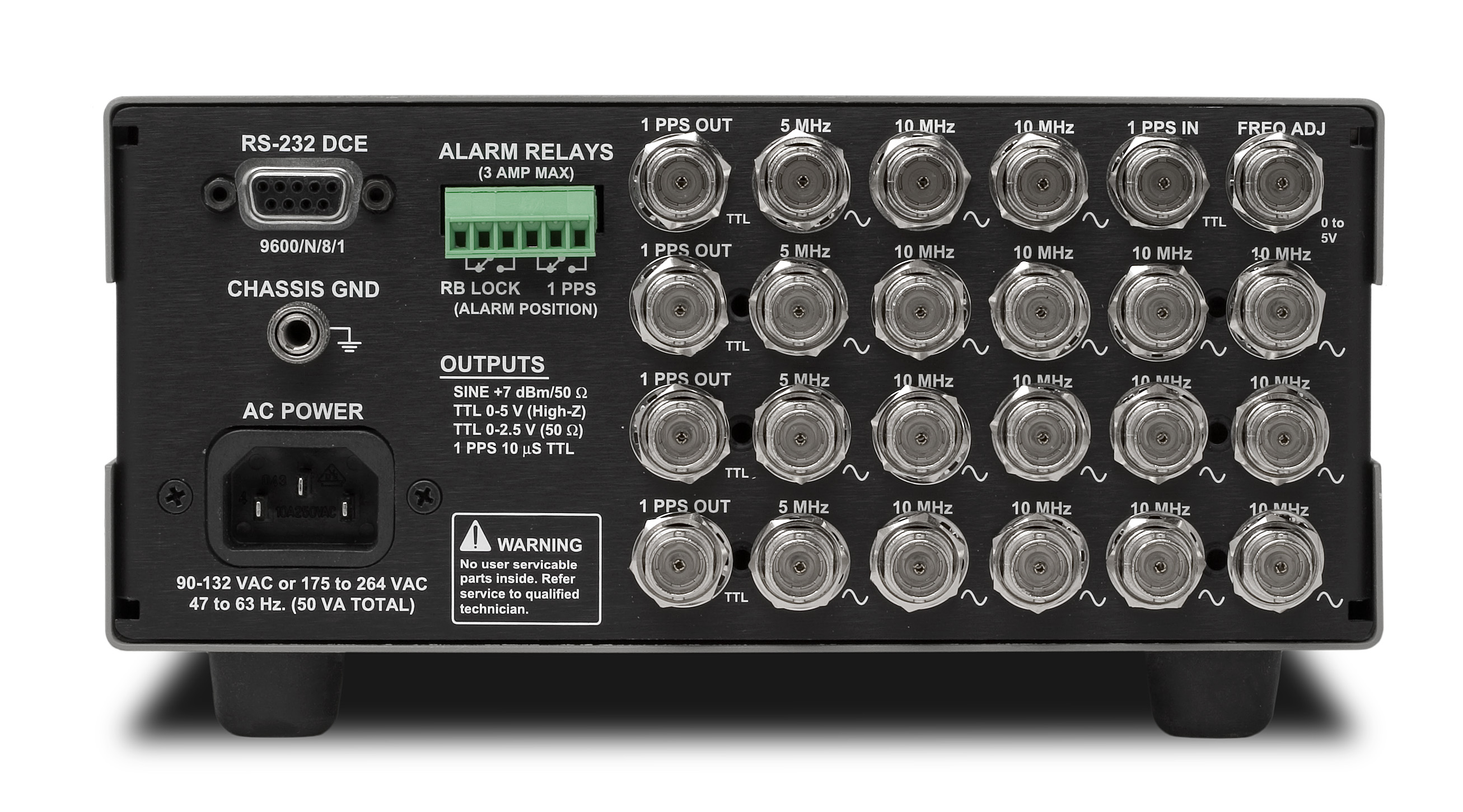
| Frequency adjust | 0 to 5 VDC adjusts frequency by ±0.002 ppm (normally unconnected) |
| 1 pps input | One 100 kΩ input. Requires CMOS level pulses (0 to 5 VDC). If an external 1 pps input is applied, lock is maintained between the 1 pps input and 1 pps output with computer adjustable time constant from 8 minutes to 18 hours. |
| 10 MHz outputs | Two 50 Ω isolated sine outputs |
| 5 MHz output | One 50 Ω sine output |
| 1 pps output | One 50 Ω pulse output |
| Optional outputs | Each option board provides four 10 MHz, one 5 MHz and one 1 pps outputs. Up to 3 boards can be installed. |
| Alarm relays | Max. current, 3 A. SPDT, normally open or normally closed. May be wired in parallel with other relays to "wire-or" a single alarm. |
| Rb lock | Relay status matches the front-panel "Locked" LED. |
| 1 pps | Relay status matches the front-panel "1 pps sync" LED |
| RS-232 | 9-pin connector configured as DCE, 9600 baud. Windows RbMon software is provided. |
Environmental |
|
| Operating temperature | +10 °C to +40 °C |
| Temperature stability | Δf/f < ±1 × 10⁻¹⁰ (+10 °C to +40 °C) |
| Storage temperature | -55 °C to +85 °C |
| Magnetic field | Δf/f < 2 × 10⁻¹⁰ for 1 Gauss field reversal |
| Relative humidity | 95 % (non-condensing) |
General |
|
| AC power | 90 to 132 VAC or 175 to 264 VAC, 47 to 63 Hz, 50 W |
| Dimensions | 8.5" × 3.5" × 13" (WHL) |
| Weight | 9 lbs. |
| Warranty | One year parts and labor on defects in materials and workmanship |
FS725 Specifications |
|
Output |
|
| Output frequencies | 10 MHz sine, 5 MHz sine, 1 pps pulse (10 µs wide) |
| Amplitude | 0.5 Vrms, ±10 % |
| 1 pps pulse amplitude | 2.5 V into 50 Ω, 5 V into high-impedance loads |
| Phase noise (SSB) | <-130 dBc/Hz (10 Hz) <-140 dBc/Hz (100 Hz) <-150 dBc/Hz (1 kHz) <-155 dBc/Hz (10 kHz) |
| Spurious | <-100 dBc (100 kHz BW) |
| Harmonics | <-40 dBc |
| Accuracy at shipment | ±5 × 10-11 |
| Aging (after 30 days) | |
| Monthly | <5 × 10-11 <2.5 × 10⁻¹¹ (at shipment) with opt. C |
| Yearly | <5 × 10⁻¹⁰ |
| 20 years (typ.) | 5 × 10⁻⁹ |
| Short term stability (Allan variance) |
<2 × 10-11 (1 s) <1 × 10-11 (10 s) <2 × 10-12 (100 s) |
| Holdover | 72 hour Stratum 1 level (1 × 10-11) |
| Frequency retrace | ±5 × 10-11 (72 hrs. off, then 72 hrs. on) |
| Settability | <5 × 10-12 |
| Trim range | ±2 × 10⁻⁹ (0 to 5 VDC) ±0.5 ppm (via RS-232) |
| Warm-up time | <6 minutes (time to lock) <7 minutes (time to 1 × 10⁻⁹) |
Front-Panel Indicators |
|
| Power | "On" when AC power is applied |
| Locked | "On" when frequency is locked to rubidium |
| 1 pps input | Blinks with each 1 pps reference input applied to rear panel |
| 1 pps sync | "On" when 1 pps output is synchronized within ±1 µs of 1 pps input |
| Receive | Blinks when RS-232 characters are received by FS725 |
| Send | Blinks when RS-232 characters are sent by FS725 |
Rear-Panel Connections |
|
| Frequency adjust | 0 to 5 VDC adjusts frequency by ±0.002 ppm (normally unconnected) |
| 1 pps input | One 100 kΩ input. Requires CMOS level pulses (0 to 5 VDC). If an external 1 pps input is applied, lock is maintained between the 1 pps input and 1 pps output with computer adjustable time constant from 8 minutes to 18 hours. |
| 10 MHz outputs | Two 50 Ω isolated sine outputs |
| 5 MHz output | One 50 Ω sine output |
| 1 pps output | One 50 Ω pulse output |
| Optional outputs | Each option board provides four 10 MHz, one 5 MHz and one 1 pps outputs. Up to 3 boards can be installed. |
| Alarm relays | Max. current, 3 A. SPDT normally open or normally closed. May be wired in parallel with other relays to "wire-or" a single alarm. |
| Rb lock | Relay status matches the front-panel "Locked" LED. |
| 1 pps | Relay status matches the front-panel "1 pps sync" LED |
| RS-232 | 9-pin connector configured as DCE, 9600 baud. Windows RbMon software is provided. |
Environmental |
|
| Operating temperature | +10 °C to +40 °C |
| Temperature stability | Δf/f < ±1 × 10⁻¹⁰ (+10 °C to +40 °C) |
| Storage temperature | -55 °C to +85 °C |
| Magnetic field | Δf/f < 2 × 10⁻¹⁰ for 1 Gauss field reversal |
| Relative humidity | 95 % (non-condensing) |
General |
|
| AC power | 90 to 132 VAC or 175 to 264 VAC, 47 to 63 Hz, 50 W |
| Dimensions | 8.5" × 3.5" × 13" (WHL) |
| Weight | 9 lbs. |
| Warranty | One year parts and labor on defects in materials and workmanship |



