SIM970 Specifications |
| Number of channels |
4 |
| Number of digits |
5½ (±199999 counts)[ 1 ] |
| Full-scale ranges |
| Range 1 |
±19.9999 V, 100 µV res.,
1.5 counts noise (rms) [ 1, 2 ] |
| Range 2 |
±1.99999 V, 10 µV res.,
0.8 counts noise (rms) [ 1, 2 ] |
| Range 3 |
±999.99 mV, 10 µV res.,
0.8 counts noise (rms) [ 1, 2 ] |
| Range 4 |
±199.999 mV, 1 µV res.,
1.0 counts noise (rms) [ 1, 2 ] |
| Accuracy |
±(% of reading + counts)[ 3 ] |
| Range 1[ 4 ] |
0.0010 + 2 (24 hr.), 0.0050 + 2 (90 day),
0.0080 + 2 (1 yr.) |
| Range 2 |
0.0002 + 2 (24 hr.), 0.0050 + 2 (90 day),
0.0080 + 2 (1 yr.) |
| Range 3 |
0.0002 + 2 (24 hr.), 0.0050 + 2 (90 day),
0.0080 + 2 (1 yr.) |
| Range 4 |
0.0002 + 4 (24 hr.), 0.0050 + 6 (90 day),
0.0080 + 6 (1 yr.) |
| Transfer accuracy |
(24 hour counts error)/2 [ 3 ][ 5 ] (typ.) |
| Input resistance |
10 MΩ ± 1 %, >3 GΩ selectable on ranges 2 to 4 [ 6 ] |
| Input terminals |
BNC (Amphenol 31-10 or similar) |
| Input protection |
±60 V center to shield, ±200 V shield to earth |
| Triggering |
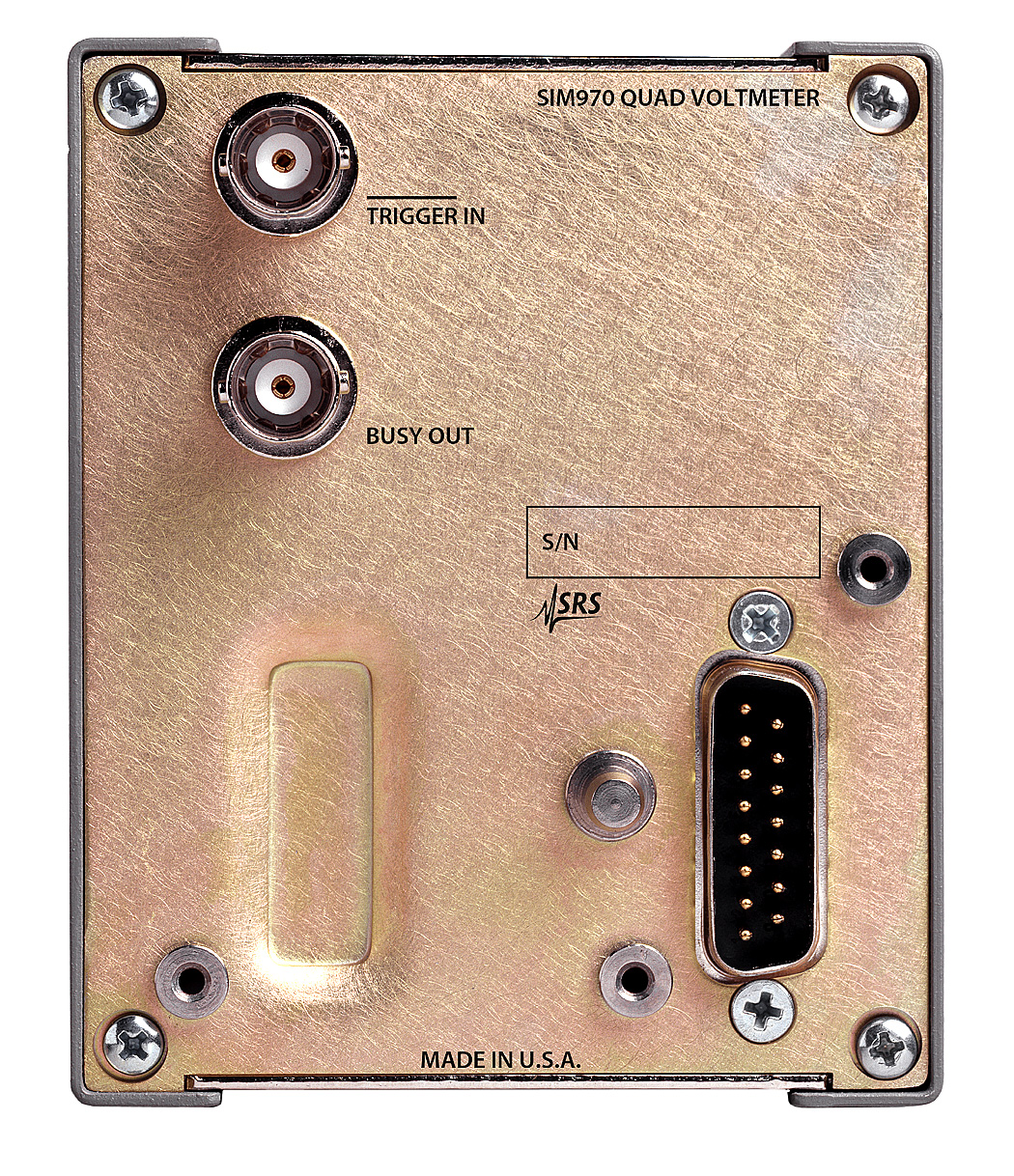
Internal, external (TTL), or remote |
| BUSY output |
TTL logic high when busy |
| Update rate [ 7 ] |
3.6/s (60 Hz), 3.0/s (50 Hz) |
| Normal mode rejection |
90 dB (59 Hz to 61 Hz or 49 Hz to 51 Hz) |
| CMRR (at DC) |
125 dB (for 1 kΩ unbalance in the shield) |
| Settling time |
1 s to within 3 counts of final reading on ranges 1 to 3, 8 s on range 4 |
| Display |
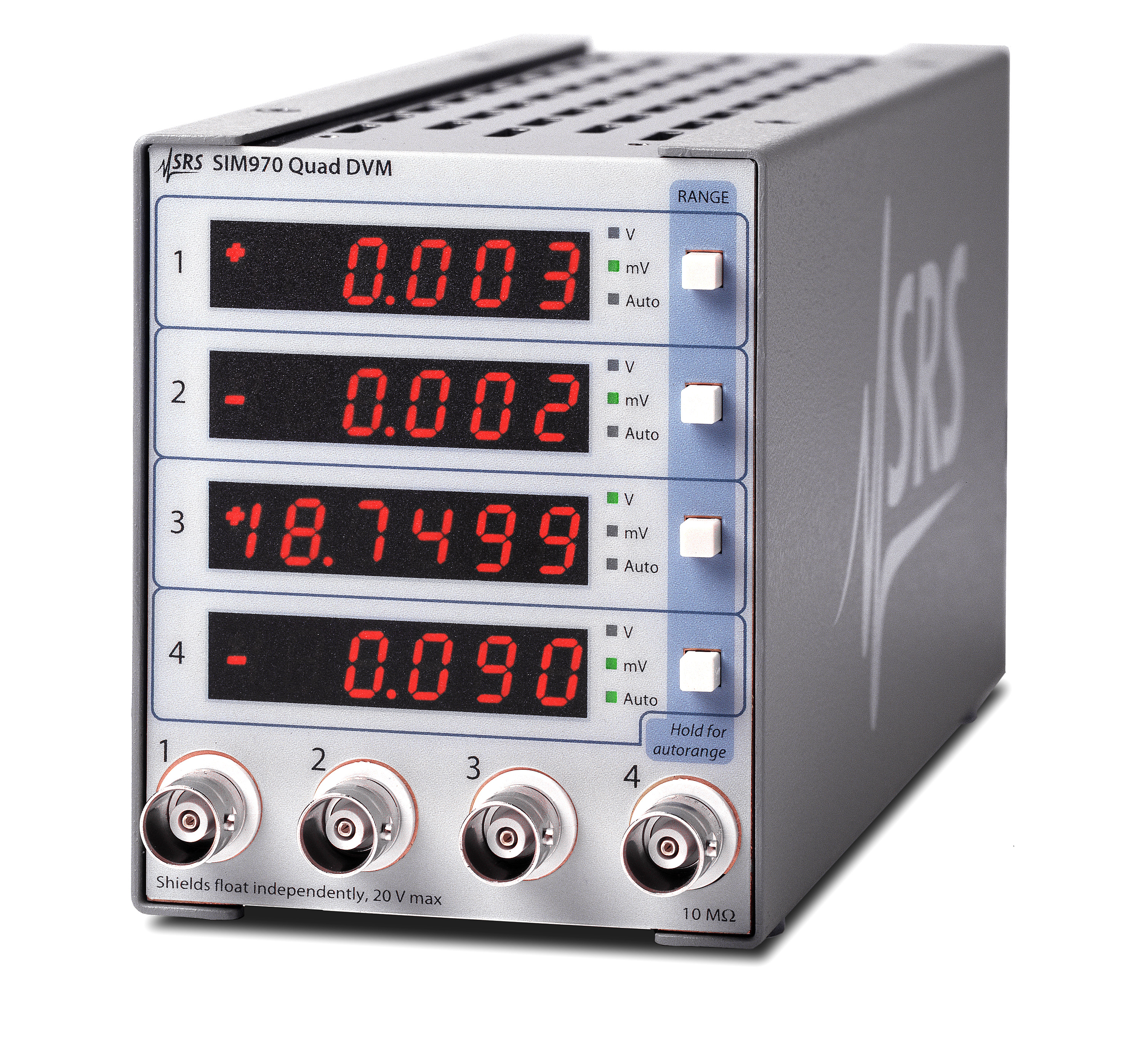
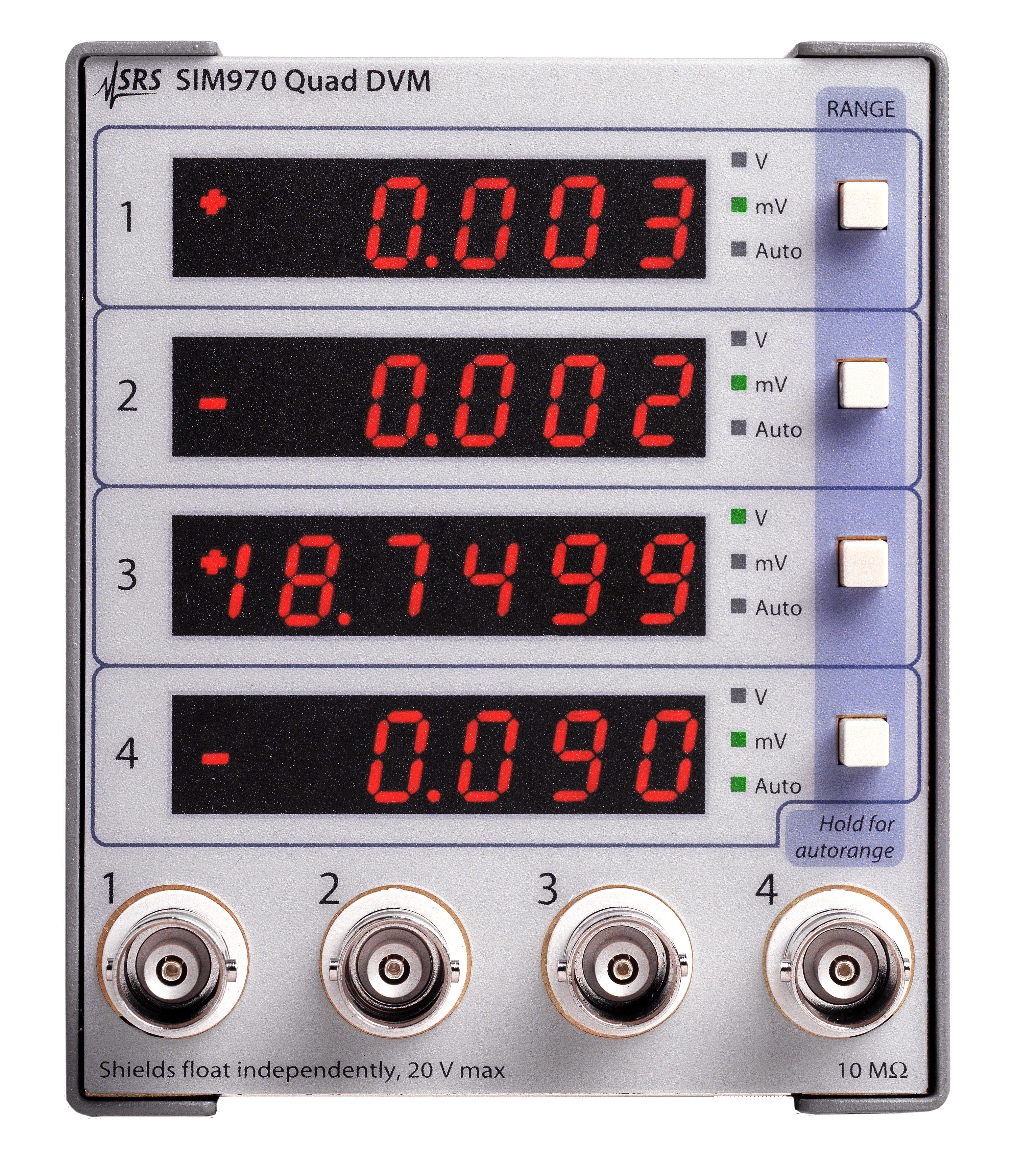
Red LED, 0.40", with polarity indication. Green LED for range and autorange indication |
| Operating temperature |
0 °C to 40 °C
(non-condensing) |
| Interface |
Serial via SIM interface |
| Connectors |
BNC (4 front, 2 rear)
DB15 (male) SIM interface |
| Power |
Power supplied by the SIM900 Mainframe, or optionally by a user-supplied DC power supply (+5 V) |
| Dimensions |
3.0" × 3.6" × 7.0" (WHL) |
| Weight |
2.3 lbs. |
| Warranty |
One year parts and labor on defects in materials and workmanship |
|
|
| Notes |
[ 1 ] One count is a unit change in the least-significant digit. Greater resolution is available through the remote interface
[ 2 ] Measured over 360 consecutive readings
[ 3 ] Inside SIM900 mainframe following a two hour warmup, autozero ON
[ 4 ] Scale calibration ON
[ 5 ] Within 10 minutes and ±0.5 °C, within ±10 % of the initial value, fixed range, input between 10 % and 100 % of full scale
[ 6 ] Input bias current is <1 pA at 23 °C
[ 7 ] Internal triggering, autozero ON. Rate is double for autozero OFF |